
Emmental
In its own language: Emmentaler
A yellow Swiss cheese with natural holes and a mild savoury taste.
Emmental is a medium-hard cow's milk cheese from the Emme Valley in Switzerland. It features large natural holes and offers a mild savoury flavour. The cheese is eaten cold or melted in dishes like gratins.
- Holes come from bacterial gas around hay dust.
- Requires three specific bacteria strains to make.
- Protected as AOP in Switzerland since 2013.
- Ziger is a whey cheese byproduct of making it.
- Eaten cold or melted in gratins.
What is Emmental?
This cheese presents a yellow paste with a medium-hard texture. Large natural holes dot the interior. It comes from the Emme Valley in Switzerland. The flavour is mild yet savoury. It belongs to the family of Swiss-type cheeses. The rind is natural. The cheese is often sold in chunks or slices. Its appearance is distinct due to the eye formation.
Where does Emmental come from?
The cheese began in the Emme Valley of Switzerland. The name Emmentaler holds geographical protection there. Several other nations also recognise similar names as protected indications. France produces Emmental de Savoie. Germany makes Allgäuer Emmentaler. These varieties have their own protected status under European law. The original Swiss version remains the reference point for this style.
What does Emmental taste like?
The taste is described as savoury but gentle. It lacks sharpness. The texture is firm but not hard. As it ages, the character may deepen slightly. The holes do not affect the flavour directly. They are a visual marker of quality. The aroma matches the mild profile. It is pleasant without being overpowering.
How Emmental is made
Three bacteria types are essential. Streptococcus thermophilus helps start fermentation. Lactobacillus helveticus aids acid development. Propionibacterium freudenreichii creates the gas for holes. Hay dust in milk used to cause imperfections. Now, holes signal good maturation. Acoustic tests check the structure. Ziger, a whey cheese, is made alongside it. Modern machines reduce dust intake.
Emmental, drawn
How Emmental is eaten and cooked
People eat it cold as a snack. Slices go into sandwiches. Chunks sit on boards. It melts well in cooking. Gratins benefit from its properties. It blends into hot dishes smoothly. The texture holds up when heated. It does not become stringy. Cooks value it for consistency.
Emmental through the day
It works for casual snacking. Slices pair with drinks. It fits lunch boxes. Melting uses suit dinner sides. Gratin dishes serve as main courses. It appears on cheese boards. It is not typically a breakfast item. It serves well at gatherings.
Emmental in the world's kitchens
Swiss cuisine claims its origin. French cooks use Emmental de Savoie. German recipes call for Allgäuer versions. Dutch makers produce Maasdam. Norwegian Jarlsberg follows the style. Turkish Kars gravyer adapts it. Uruguayan Colonia cheese imitates the form. Each region adds local touches.
At a glance: where it turns up
By meal and use


Faith and ritual
No specific religious ties exist. It is not tied to fasting rules. Monasteries do not make it exclusively. It is a secular dairy product. No dietary restrictions apply broadly. It is available widely.
Emmental at celebrations
It is not linked to specific festivals. It is an everyday food. People eat it regularly. It does not mark weddings. It is not a holiday special. It supports daily meals.
Custom and folk tradition
Rural dairies still make the AOC version. Raw milk is required there. Only natural ingredients are allowed. Traditional cellars age the wheels. This method preserves heritage. Modern factories differ. The old ways remain valued locally.
Buying, keeping and serving Emmental
Keep it wrapped in wax paper. Refrigerate to maintain freshness. Slice only what you need. The rind protects the inside. Do not freeze if possible. Use within a few weeks after opening.
What to use instead of Emmental
Jarlsberg offers a similar taste. Maasdam is another option. Grevé from Sweden works too. Colonia cheese mimics the look. Any Swiss-style cheese substitutes. Look for mild nutty notes.
Protection and trade
Switzerland protects Emmentaler strictly. Cantons like Bern and Luzern produce it. Other countries have their own labels. The US calls many versions Swiss cheese. Imitations are common globally. Production figures vary by region. Exports reach many markets.
Dishes with Emmental
Questions people ask about Emmental
Where does Emmental come from?
It originates in the Emme Valley in Switzerland. The name reflects this geographic source. Other regions now produce similar styles under protected names.
What milk is used to make it?
It is made from cow's milk. Traditional Swiss versions use raw milk. Pasteurized milk is common elsewhere.
Why does it have holes?
Bacteria produce gas that forms holes. Hay dust particles help start this process. Modern techniques control hole size carefully.
How should I eat it?
Eat it cold in slices or chunks. Melt it in gratins or hot dishes. It pairs well with bread and fruit.
Is it the same as Swiss cheese?
Not always. In the US, the terms mix. In Europe, Emmental is specific. Many imitations exist globally under different names.
Good reading and sources
- Geographical indications and quality schemes explainedEuropean Commission, Article
- Swiss scientists plug hole in cheese knowledgeThe Guardian, Article
The facts on this page come from the Wikipedia article "Emmental cheese", written by its contributors and used under the CC BY-SA 4.0 licence, and from its Wikidata record (CC0). EveryCheese rewrote the text in its own words, with AI assistance, and compares every page with the article to make sure no passage is copied. It may be reused under the same CC BY-SA 4.0 licence with a link back.
It may contain mistakes. Recipes, ageing and customs differ from one dairy, valley or kitchen to the next. Folk beliefs are described as tradition, never as advice. If something is wrong, tell us. Last refreshed 2026-10-15.
More from Switzerland
All the cheeses of Switzerland 🇨🇭 Switzerland and 5 moreEmmentalEmmentaler
A yellow, medium-hard Swiss cheese with natural holes, aged for several months.Cow · Semi-hard · Savoury and brothy
🇨🇭 Switzerland and 5 moreEmmentalEmmentaler
A yellow, medium-hard Swiss cheese with natural holes, aged for several months.Cow · Semi-hard · Savoury and brothy
 🇩🇪 Germany and 2 moreTilsitTilsiter
A semi-hard smear-ripened cow's milk cheese from East Prussia with a dark yellow rind.Cow · Semi-hard · Savoury and brothy
🇩🇪 Germany and 2 moreTilsitTilsiter
A semi-hard smear-ripened cow's milk cheese from East Prussia with a dark yellow rind.Cow · Semi-hard · Savoury and brothy
 🇨🇭 Switzerland and 1 moreTête de Moine
A semi-hard Swiss cow's milk cheese shaved into rosettes with a special tool.Cow · Semi-hard · Savoury and brothy
🇨🇭 Switzerland and 1 moreTête de Moine
A semi-hard Swiss cow's milk cheese shaved into rosettes with a special tool.Cow · Semi-hard · Savoury and brothy
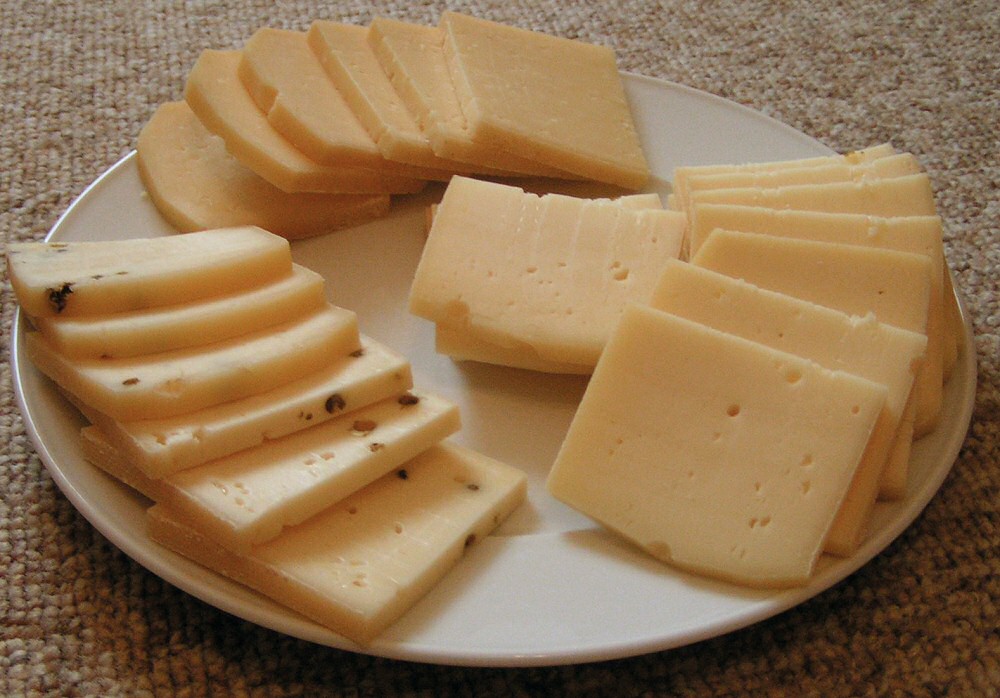 🇨🇭 SwitzerlandRaclette du ValaisWalliser Raclette
A semi-hard Swiss cow's-milk cheese from Valais, aged for melting or eating.Cow · Semi-hard
🇨🇭 SwitzerlandRaclette du ValaisWalliser Raclette
A semi-hard Swiss cow's-milk cheese from Valais, aged for melting or eating.Cow · Semi-hard
Its cousins elsewhere
All semi-hard cheeses 🇾🇪 YemenYemeni cheeseجبنة تعز
A smoked semi-hard sheep or goat milk cheese from Taiz Governorate in Yemen.Sheep · Semi-soft · Savoury and brothy
🇺🇸 United StatesCold-pack cheese
A chilled blend of natural cheeses mixed with flavorings without cooking.Mixed · Bloomy rind · Savoury and brothy
🇾🇪 YemenYemeni cheeseجبنة تعز
A smoked semi-hard sheep or goat milk cheese from Taiz Governorate in Yemen.Sheep · Semi-soft · Savoury and brothy
🇺🇸 United StatesCold-pack cheese
A chilled blend of natural cheeses mixed with flavorings without cooking.Mixed · Bloomy rind · Savoury and brothy
 🇮🇳 IndiaKalari
A semi-soft cow or buffalo milk cheese from Jammu and Kashmir, dried and sautéed until gooey.Cow · Semi-soft · Savoury and brothy
🇮🇳 IndiaKalari
A semi-soft cow or buffalo milk cheese from Jammu and Kashmir, dried and sautéed until gooey.Cow · Semi-soft · Savoury and brothy
 🇲🇽 Mexico and 1 moreAsaderoqueso asadero
A fresh Mexican cheese made from cow and goat milk that melts easily for grilling.Cow · Fresh · Savoury and brothy
🇲🇽 Mexico and 1 moreAsaderoqueso asadero
A fresh Mexican cheese made from cow and goat milk that melts easily for grilling.Cow · Fresh · Savoury and brothy