
Tête de Moine
A semi-hard Swiss cow's milk cheese shaved into rosettes with a special tool.
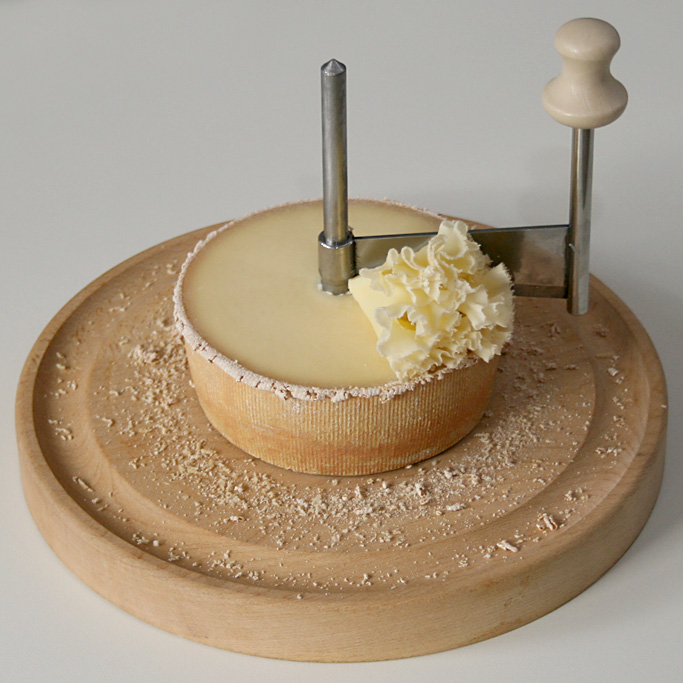
Tête de Moine is a semi-hard cheese made from raw cow's milk in the Bernese Jura of Switzerland. It is aged for at least two and a half months on spruce boards and served by shaving it into delicate rosettes using a Girolle tool.
- Made from raw cow's milk in the Swiss Jura region.
- Aged for at least 75 days on spruce boards.
- Served as rosettes shaved with a Girolle tool.
- Originated at Bellelay Abbey in the 12th century.
- Protected by AOP status since 1997.
What is Tête de Moine?
Tête de Moine is a semi-hard cheese crafted from unpasteurized cow's milk in the Swiss Jura mountains. The wheels are cylindrical, typically weighing around 850 grams, with a diameter between ten and fifteen centimeters. A firm, grainy crust covers a paste that ranges from yellow to ivory. The texture is slightly moist and supple, designed to be pared rather than sliced. This unique preparation creates thin, flower-like rosettes that maximize surface area and aroma release.
Where does Tête de Moine come from?
The cheese traces its roots to the 12th century, produced by canons at the Bellelay Abbey near Saicourt. By 1192, monastery cheese served as rent and currency. After the French Revolution displaced the canons in 1797, production moved to local farm dairies. The name, meaning 'monk's head,' likely references the tonsure or the number of cheeses stored per monk. Modern production began expanding in the 19th century, leading to the formation of producer associations in the late 20th century to protect and market the cheese globally.
What does Tête de Moine taste like?
The taste is savoury and tangy, reflecting the quality of the raw milk and the specific pastures where the cows graze. The texture is homogeneous and sticky yet supple. Shaving the cheese into rosettes allows the aroma to develop fully, enhancing the sensory experience. The salt content contributes to a distinct profile, balanced by the natural sweetness of the high-fat dry matter. The flavour deepens slightly during the aging period on spruce wood.
How Tête de Moine is made
Producers use raw cow's milk from cows fed exclusively on farm fodder or communal pastures for at least 120 days. Silage and growth hormones are prohibited. After curd formation, the cheese undergoes a salt-water bath. It then rests on spruce boards for a minimum of 75 days within the designated region. During this time, experts regularly tend the wheels. Monthly quality checks evaluate appearance, hole size, paste colour, and taste to ensure compliance with strict AOP standards.
Tête de Moine, drawn
How Tête de Moine is eaten and cooked
Tête de Moine is primarily served on a cheese board or as a snack. It is never cut with a knife; instead, a specialized tool called a Girolle shaves the wheel into intricate rosettes. These curls are best enjoyed fresh to appreciate their delicate texture. The cheese pairs traditionally with dry white wines, which complement its savoury notes. It is not typically used for melting or baking, but rather presented whole to highlight its unique serving method.
Tête de Moine through the day
This cheese fits comfortably into lunch or dinner settings, particularly when served as part of a larger meal. It is also common as a standalone snack or appetizer. The rosette presentation makes it ideal for social gatherings and cheese boards. It is not associated with breakfast or dessert traditions. Its role is that of a refined intermediate course or a light evening bite, often shared among guests.
Tête de Moine in the world's kitchens
Tête de Moine is a staple of Swiss cuisine, specifically from the French-speaking regions of the Bernese Jura and the Canton of Jura. It represents the culinary heritage of the area, linking modern tables to medieval monastic traditions. While produced locally, it is exported worldwide, introducing international diners to Swiss alpine dairy practices. The cheese remains a cultural symbol of the Jura Mountains, distinguishing itself through its specific regional methods and tools.
At a glance: where it turns up
By meal and use
Cuisines
Faith and ritual
The cheese originated in the Bellelay Abbey, where canons produced it over eight centuries ago. It was historically used to pay rents and settle legal disputes, embedding it in the economic life of the monastery. While no longer produced by monks, its origins remain tied to religious communities. The tradition of using cheese as currency reflects the spiritual and economic values of the era, though today it is a secular product protected by modern designation laws.
Tête de Moine at celebrations
There are no specific festivals or holidays directly tied to Tête de Moine consumption. However, its history as a form of payment and gift suggests it played a role in historical transactions and hospitality. Today, it is celebrated as part of the broader Culinary Heritage of Switzerland. Its production supports local rural economies and preserves traditional farming practices in the Jura region, making it a point of regional pride.
Custom and folk tradition
Local lore connects the name to the tonsure of monks, either mocking French soldiers' views or referencing storage counts. The Girolle tool, invented in 1982, revolutionized serving by mimicking chanterelle mushrooms. This innovation boosted consumption and preserved the cheese's reputation. The practice of aging on spruce boards and the strict feeding rules for cows reflect deep-rooted agricultural traditions that prioritize quality and locality over mass production.
Buying, keeping and serving Tête de Moine
The cheese is aged on spruce boards, which help maintain its moisture and texture. For consumers, keeping it wrapped in wax paper or cheese paper in the refrigerator preserves its freshness. It should be consumed relatively soon after purchase to enjoy the optimal texture. Allowing it to come to room temperature before serving enhances its aroma and flavour profile.
What to use instead of Tête de Moine
The unique shaving method and specific texture make it difficult to replace exactly. Other semi-hard Alpine cheeses might offer similar flavours, but they lack the distinctive rosette presentation and spruce-aged character. The Girolle tool is specific to this cheese style, further distinguishing it from other varieties.
Protection and trade
Tête de Moine holds AOP status, ensuring it meets strict geographical and production criteria. Production is concentrated in fewer than ten dairies in the Jura and Bernese Jura regions. The Interprofession Tête de Moine organization oversees quality and marketing. Exported globally, it serves as a calling card for Swiss cheesemaking. The protection status helps maintain traditional methods against industrial standardization.
Questions people ask about Tête de Moine
What is Tête de Moine cheese?
It is a semi-hard Swiss cheese made from raw cow's milk. It is known for being shaved into rosettes using a special tool called a Girolle, rather than being sliced.
Where does Tête de Moine come from?
It originates from the Bernese Jura and Canton of Jura in Switzerland. Production is centered in towns like Moutier, Saicourt, and Porrentruy.
How is Tête de Moine eaten?
It is served on a cheese board or as a snack. The cheese is shaved into thin curls to enhance its aroma and texture, often paired with dry white wine.
Why is it called Monk's Head?
The name likely references the tonsure of monks at Bellelay Abbey, where the cheese was first produced. It may also refer to the number of cheeses stored per resident.
Good reading and sources
- Tête de Moine on WikipediaEncyclopedia
- More photos on Wikimedia CommonsPhotos and video
- Wikidata recordOpen data
The facts on this page come from the Wikipedia article "Tête de Moine", written by its contributors and used under the CC BY-SA 4.0 licence, and from its Wikidata record (CC0). EveryCheese rewrote the text in its own words, with AI assistance, and compares every page with the article to make sure no passage is copied. It may be reused under the same CC BY-SA 4.0 licence with a link back.
It may contain mistakes. Recipes, ageing and customs differ from one dairy, valley or kitchen to the next. Folk beliefs are described as tradition, never as advice. If something is wrong, tell us. Last refreshed 2026-10-15.
More from Switzerland
All the cheeses of Switzerland 🇨🇭 Switzerland and 5 moreEmmentalEmmentaler
A yellow, medium-hard Swiss cheese with natural holes, aged for several months.Cow · Semi-hard · Savoury and brothy
🇨🇭 Switzerland and 5 moreEmmentalEmmentaler
A yellow, medium-hard Swiss cheese with natural holes, aged for several months.Cow · Semi-hard · Savoury and brothy
 🇩🇪 Germany and 2 moreTilsitTilsiter
A semi-hard smear-ripened cow's milk cheese from East Prussia with a dark yellow rind.Cow · Semi-hard · Savoury and brothy
🇩🇪 Germany and 2 moreTilsitTilsiter
A semi-hard smear-ripened cow's milk cheese from East Prussia with a dark yellow rind.Cow · Semi-hard · Savoury and brothy
 🇨🇭 SwitzerlandRaclette du ValaisWalliser Raclette
A semi-hard Swiss cow's-milk cheese from Valais, aged for melting or eating.Cow · Semi-hard
🇨🇭 SwitzerlandRaclette du ValaisWalliser Raclette
A semi-hard Swiss cow's-milk cheese from Valais, aged for melting or eating.Cow · Semi-hard
 🇫🇷 France and 1 moreTomme
A low-fat alpine cheese from France and Switzerland, often made from skimmed milk.Cow · Semi-hard · Milky and fresh
🇫🇷 France and 1 moreTomme
A low-fat alpine cheese from France and Switzerland, often made from skimmed milk.Cow · Semi-hard · Milky and fresh
Its cousins elsewhere
All semi-hard cheeses 🇮🇳 IndiaKalimpong cheese
A mild, crumbly cow's-milk cheese from a West Bengal hill station, started by a Jesuit priest.Cow · Semi-hard · Tangy and lactic
🇺🇸 United StatesCold-pack cheese
A chilled blend of natural cheeses mixed with flavorings without cooking.Mixed · Bloomy rind · Savoury and brothy
🇮🇳 IndiaKalimpong cheese
A mild, crumbly cow's-milk cheese from a West Bengal hill station, started by a Jesuit priest.Cow · Semi-hard · Tangy and lactic
🇺🇸 United StatesCold-pack cheese
A chilled blend of natural cheeses mixed with flavorings without cooking.Mixed · Bloomy rind · Savoury and brothy
 🇮🇳 IndiaKalari
A semi-soft cow or buffalo milk cheese from Jammu and Kashmir, dried and sautéed until gooey.Cow · Semi-soft · Savoury and brothy
🇨🇳 ChinaKefir cheese
A tangy, creamy cheese set using kefir culture rather than rennet or acid.Mixed · Fresh · Tangy and lactic
🇮🇳 IndiaKalari
A semi-soft cow or buffalo milk cheese from Jammu and Kashmir, dried and sautéed until gooey.Cow · Semi-soft · Savoury and brothy
🇨🇳 ChinaKefir cheese
A tangy, creamy cheese set using kefir culture rather than rennet or acid.Mixed · Fresh · Tangy and lactic