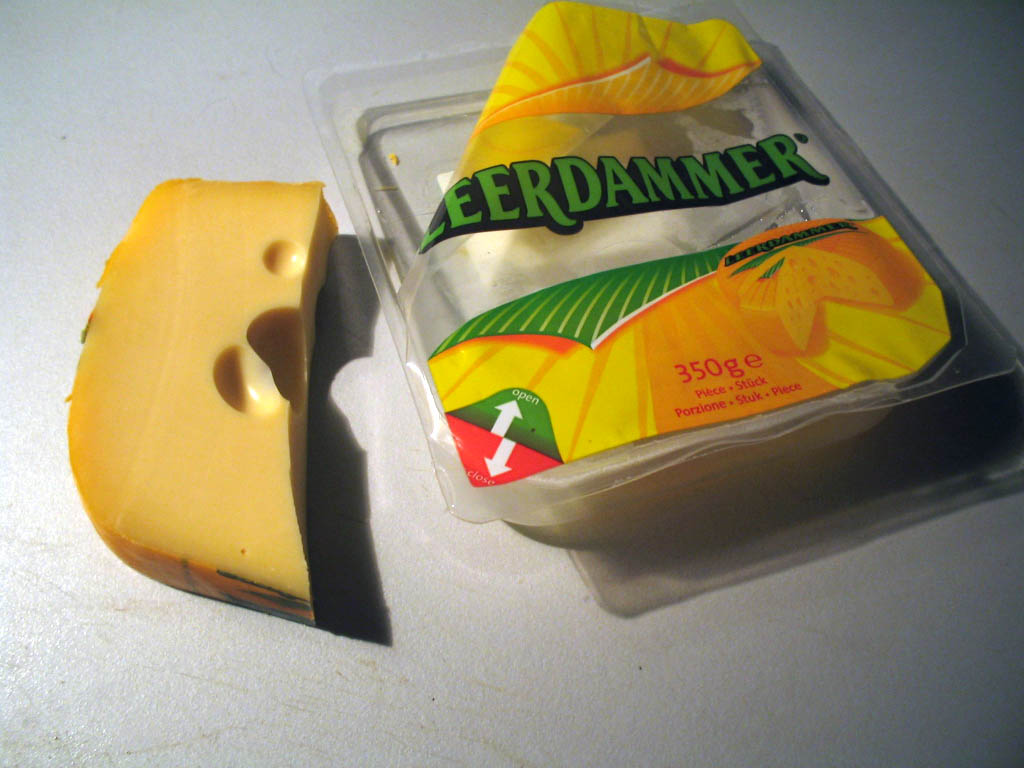
Leerdammer
A Dutch semihard cow's-milk cheese with holes and a sweet nutty taste.
Leerdammer is a trademarked semihard cheese from the Netherlands made from pasteurized cow's milk. It features large holes and a pale yellow paste that tastes sweet and nutty, becoming sharper as it ages for up to a year.
- Created in 1977 by Cees Boterkooper and Bastiaan Baars.
- Named after the Dutch town of Leerdam.
- Large holes form from carbon dioxide gas during ripening.
- Flavor is sweet and nutty, intensifying with age.
- Owned by Bel Group, now under Lactalis control.
What is Leerdammer?
Leerdammer is a branded semihard cheese produced in the Netherlands. The paste is pale yellow and creamy, marked by large holes formed during ripening. These bubbles are known as eyes and result from carbon dioxide gas released by bacteria. The flavor profile is sweet and nutty, designed to resemble Emmental. As the cheese matures, its taste becomes more pronounced. The brand is owned by Bel Leerdammer B.V., a subsidiary of the Bel Group.
Where does Leerdammer come from?
The cheese was created through a collaboration between Cees Boterkooper and Bastiaan Baars in 1970. Boterkooper ran a dairy in Schoonrewoerd since 1914, while Baars operated a local cheese shop. They aimed to produce a product that could rival Gouda and Edam. Leerdammer launched in 1977, named after the town of Leerdam. The generic style is often called Maasdam elsewhere.
What does Leerdammer taste like?
The taste is distinctly sweet with nutty undertones. This character intensifies as the cheese ages. The texture remains creamy throughout its shelf life. The large holes contribute to a unique mouthfeel. Marketing campaigns have highlighted these gaps, suggesting the best flavor lies between them. The overall profile is mild yet evolving.
How Leerdammer is made
Producers use pasteurized cow's milk to create this cheese. The process involves setting the curd and then pressing it into wheels. During ripening, specific bacteria generate carbon dioxide, which creates the signature holes. The aging period lasts between three and twelve months. Production occurs at facilities in Schoonrewoerd, Dalfsen, and France.
Leerdammer, drawn
How Leerdammer is eaten and cooked
This cheese works well on snack plates or cheese boards. Its melting properties make it suitable for hot dishes. Cooks often grate it over pasta or bake it into casseroles. The mild sweetness pairs easily with fruits and bread. It serves as a versatile ingredient in everyday cooking.
Leerdammer through the day
Leerdammer fits comfortably into lunch or dinner settings. It is commonly served as a standalone snack. Slices appear frequently on cheese boards alongside other varieties. The melting quality allows it to feature in warm meals. It is not typically associated with breakfast or dessert courses.
Leerdammer in the world's kitchens
The cheese belongs firmly to Dutch culinary traditions. It was developed to compete with national staples like Gouda. While produced in France, its identity remains rooted in the Netherlands. Consumers in Europe, Russia, and the US encounter it in supermarkets. It represents a modern interpretation of Swiss-style cheeses.
At a glance: where it turns up
By meal and use
Cuisines
Faith and ritual
No religious associations or ritual uses are linked to this cheese. It is an industrial product without monastic or pastoral ties. There are no specific dietary laws or fasting rules connected to its consumption. It is treated as a secular food item.
Leerdammer at celebrations
There are no specific festivals or holiday tables dedicated to Leerdammer. It is available year-round in retail stores. The cheese does not mark weddings, births, or seasonal changes. It is consumed as part of daily eating habits rather than special occasions.
Custom and folk tradition
The creation story involves two local entrepreneurs meeting in 1970. Their goal was to innovate within the Dutch cheese market. The brand has changed ownership, moving to Lactalis in 2021. Despite corporate shifts, the production methods remain consistent. The cheese reflects modern industrial cheesemaking rather than ancient folk customs.
Buying, keeping and serving Leerdammer
Keep the cheese wrapped in wax paper or plastic in the refrigerator. Consume it within a few weeks of opening for best flavor. The holes do not affect storage requirements. Avoid freezing if possible to maintain texture. Serve at room temperature to enhance the nutty notes.
What to use instead of Leerdammer
Maasdam is the generic name for this style of cheese. Emmental offers a similar holey appearance and nutty taste. Jarlsberg is another comparable option found in various countries. These alternatives can replace Leerdammer in recipes requiring melting or grating.
Protection and trade
Leerdammer is a registered trademark held by Bel Leerdammer B.V. The Bel Group produces the cheese exclusively. In 2021, assets were transferred to Lactalis. The brand is sold internationally in Europe, Russia, and the United States. Generic versions exist under different names in some markets.
Questions people ask about Leerdammer
Where does Leerdammer cheese come from?
It originates in the Netherlands, specifically named after the town of Leerdam. Production also takes place in France and other Dutch locations like Schoonrewoerd and Dalfsen.
What kind of milk is used to make it?
Leerdammer is made exclusively from pasteurized cow's milk. This gives it a creamy texture and a pale yellow color typical of many Dutch cheeses.
Why does it have holes?
The holes, or eyes, are caused by bacteria that release carbon dioxide gas as the cheese ripens. This is a characteristic feature of Swiss-style cheeses.
How would you describe the taste?
It has a sweet and somewhat nutty flavor. The taste becomes more pronounced and sharper as the cheese ages for several months.
Good reading and sources
- Leerdammer on WikipediaEncyclopedia
- More photos on Wikimedia CommonsPhotos and video
- Wikidata recordOpen data
The facts on this page come from the Wikipedia article "Leerdammer", written by its contributors and used under the CC BY-SA 4.0 licence, and from its Wikidata record (CC0). EveryCheese rewrote the text in its own words, with AI assistance, and compares every page with the article to make sure no passage is copied. It may be reused under the same CC BY-SA 4.0 licence with a link back.
It may contain mistakes. Recipes, ageing and customs differ from one dairy, valley or kitchen to the next. Folk beliefs are described as tradition, never as advice. If something is wrong, tell us. Last refreshed 2026-10-15.
More from the Netherlands
All the cheeses of the Netherlands 🇨🇭 Switzerland and 5 moreEmmentalEmmentaler
A yellow, medium-hard Swiss cheese with natural holes, aged for several months.Cow · Semi-hard · Savoury and brothy
🇨🇭 Switzerland and 5 moreEmmentalEmmentaler
A yellow, medium-hard Swiss cheese with natural holes, aged for several months.Cow · Semi-hard · Savoury and brothy
 🇳🇱 Netherlands and 5 moreEdamEdammer
A semi-hard Dutch cow's-milk cheese aged in distinctive red wax spheres.Cow · Semi-hard · Nutty
🇳🇱 Netherlands and 5 moreEdamEdammer
A semi-hard Dutch cow's-milk cheese aged in distinctive red wax spheres.Cow · Semi-hard · Nutty
 🇳🇱 NetherlandsMaasdam
A semi-hard Dutch cow's milk cheese with holes, aged for one to three months.Cow · Semi-hard · Nutty
🇳🇱 NetherlandsMaasdam
A semi-hard Dutch cow's milk cheese with holes, aged for one to three months.Cow · Semi-hard · Nutty
 🇳🇱 NetherlandsLeyden cheeseLeidse kaas
A semi-hard Dutch cow's-milk cheese flavoured with cumin and caraway seeds.Cow · Semi-hard · Savoury and brothy
🇳🇱 NetherlandsLeyden cheeseLeidse kaas
A semi-hard Dutch cow's-milk cheese flavoured with cumin and caraway seeds.Cow · Semi-hard · Savoury and brothy
Its cousins elsewhere
All semi-hard cheeses 🇸🇾 SyriaTresseجبنة مشللة
A braided Syrian string cheese with a nutty aroma and springy texture.Cow · Semi-soft · Nutty
🇵🇰 Pakistan and 1 moreKadchgall
A hard, sweet and salty cylindrical cheese made from sheep or camel milk by Pashtun communities.Sheep · Hard · Sweet and caramel
🇸🇾 SyriaTresseجبنة مشللة
A braided Syrian string cheese with a nutty aroma and springy texture.Cow · Semi-soft · Nutty
🇵🇰 Pakistan and 1 moreKadchgall
A hard, sweet and salty cylindrical cheese made from sheep or camel milk by Pashtun communities.Sheep · Hard · Sweet and caramel
 🇮🇳 India and 2 moreKhoa
A soft South Asian cheese made by simmering whole milk until thick and dry.Cow · Fresh · Milky and fresh
🇮🇳 India and 2 moreKhoa
A soft South Asian cheese made by simmering whole milk until thick and dry.Cow · Fresh · Milky and fresh
 🇷🇴 Romania and 4 moreUrdaurdă
A fresh whey cheese from Southeast Europe and Hungary, made by boiling leftover milk liquid.Mixed · Fresh · Milky and fresh
🇷🇴 Romania and 4 moreUrdaurdă
A fresh whey cheese from Southeast Europe and Hungary, made by boiling leftover milk liquid.Mixed · Fresh · Milky and fresh