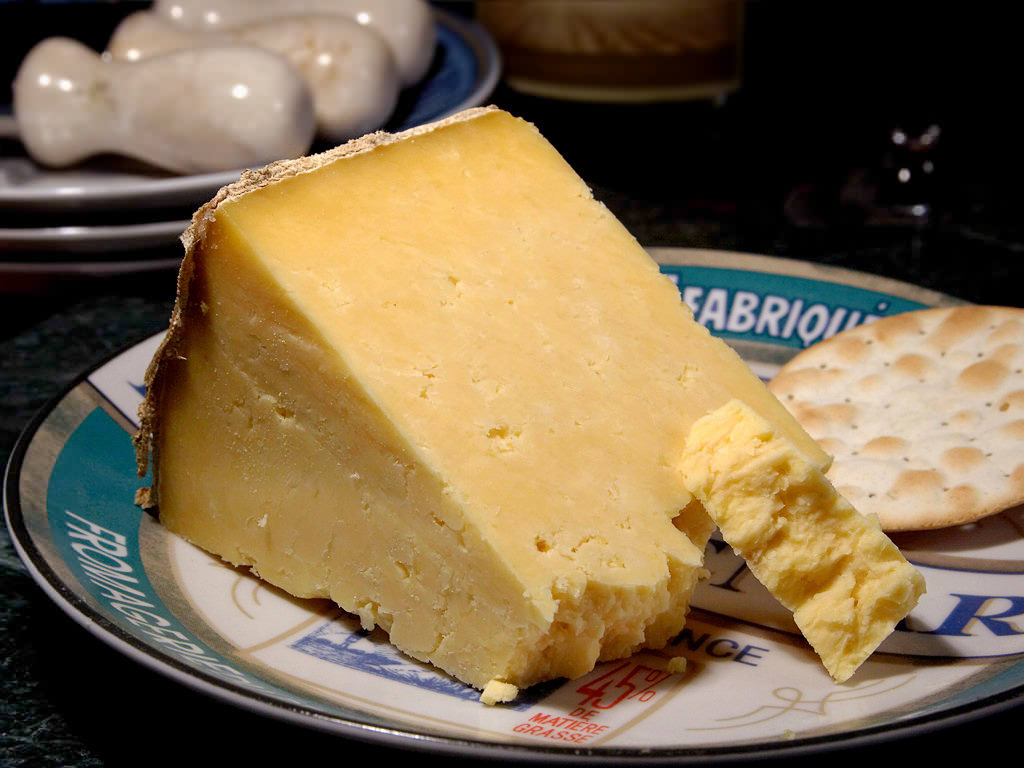
Cheshire
A dense, crumbly cow's-milk cheese from the English county of Cheshire.
Cheshire is a hard, crumbly cheese made from cow's milk in the English counties of Cheshire, Shropshire, Staffordshire, Denbighshire and Flintshire. It has a mild, salty taste and comes in white, red with annatto, or blue-veined varieties.
- One of Britain's oldest recorded cheeses, mentioned c. 1580.
- Dense, crumbly texture with a mild, salty taste.
- Produced in Cheshire and neighbouring English/Welsh counties.
- Available in white, red (annatto), and blue-veined varieties.
- Peaked at 40,000 tonnes in 1960; now ~6,000 tonnes/year.
What is Cheshire?
Cheshire is a dense, semi-hard cheese known for its moist, crumbly texture. Made from cow's milk, it typically has a mild, salty flavour. The paste is usually white, though some versions are coloured orange with annatto or feature blue veins. It is a distinct group of cheeses from northern England, including varieties like Wensleydale and Crumbly Lancashire.
Where does Cheshire come from?
Cheshire is one of Britain's oldest recorded cheeses, mentioned by Thomas Muffet around 1580. A myth links it to the Domesday Book of 1086. By the late 18th century, it was the market leader, stocked on Royal Navy ships. Production peaked at 40,000 tonnes in 1960 before declining as other cheeses gained popularity. It remains the UK's top-selling crumbly cheese.
What does Cheshire taste like?
The cheese offers a mild, salty taste with a crumbly consistency. Industrial versions may be drier and less crumbly, resembling mild Cheddar for easier processing. Blue Cheshire has veins but is less creamy than Stilton. Red Cheshire is coloured with annatto, while the original white version dominates production.
How Cheshire is made
Milk is pasteurised frequently. The cheese is aged for 4 to 8 weeks, depending on the variety. Historically, older, harder cheeses were made for transport to London. Younger, fresher styles became popular in the 19th century for industrial areas. Red Cheshire was developed in North Wales hills.
Cheshire, drawn
How Cheshire is eaten and cooked
Cheshire is eaten as a standalone cheese or used in cooking. Its crumbly texture makes it suitable for grating or crumbling over dishes. It can be served on a board or included in meals where a mild, salty cheese is desired. The blue variety was historically favoured in London clubs.
Cheshire through the day
It fits into lunch or dinner settings, often served on a cheese board. Its mild flavour suits everyday eating rather than specific feast occasions. It is not typically associated with breakfast or dessert.
Cheshire in the world's kitchens
Cheshire is central to English cuisine, particularly in the north and midlands. It is produced in Cheshire, Shropshire, Staffordshire, Denbighshire, and Flintshire. The cheese reflects local dairy traditions and has been a staple in British markets for centuries.
Cheshire at celebrations
The cheese is not tied to specific festivals or celebrations in the provided information.
Custom and folk tradition
Cheshire cheese holds a place in British culinary history, noted for its longevity and market dominance. The development of red Cheshire in North Wales highlights regional trade influences. Its production decline mirrors broader shifts in UK cheese consumption.
Buying, keeping and serving Cheshire
Younger cheeses require shorter storage times. Historically, harder varieties were aged to withstand transport. Modern storage focuses on maintaining moisture and texture for crumbly varieties.
What to use instead of Cheshire
Industrial versions may resemble mild Cheddar due to drier, less crumbly textures. Other northern crumbly cheeses like Wensleydale or Crumbly Lancashire belong to the same family.
Protection and trade
Production peaked at 40,000 tonnes in 1960, dropping to around 6,000 tonnes annually. It remains the UK's largest-selling crumbly cheese. Nantwich hosted the International Cheese Awards until 2021. No protected status is currently held.
Dishes with Cheshire
Questions people ask about Cheshire
Where does Cheshire cheese come from?
It originates in the English county of Cheshire and extends to Shropshire, Staffordshire, Denbighshire, and Flintshire. It is one of Britain's oldest named cheeses.
What kind of milk is used to make Cheshire cheese?
Cheshire cheese is made exclusively from cow's milk. The milk is frequently pasteurised during production.
What does Cheshire cheese taste like?
It has a mild, salty flavour. The texture is dense and crumbly, though industrial versions may be drier and more similar to mild Cheddar.
Are there different types of Cheshire cheese?
Yes, it comes in white, red (coloured with annatto), and blue-veined varieties. White is the most common, while blue was revived after ceasing production in the 1980s.
Good reading and sources
- Cheshire cheese on WikipediaEncyclopedia
- More photos on Wikimedia CommonsPhotos and video
- Wikidata recordOpen data
The facts on this page come from the Wikipedia article "Cheshire cheese", written by its contributors and used under the CC BY-SA 4.0 licence, and from its Wikidata record (CC0). EveryCheese rewrote the text in its own words, with AI assistance, and compares every page with the article to make sure no passage is copied. It may be reused under the same CC BY-SA 4.0 licence with a link back.
It may contain mistakes. Recipes, ageing and customs differ from one dairy, valley or kitchen to the next. Folk beliefs are described as tradition, never as advice. If something is wrong, tell us. Last refreshed 2026-10-15.
More from the United Kingdom
All the cheeses of the United Kingdom 🇬🇧 United Kingdom and 1 moreMarble cheese
A processed cow's milk cheese with distinct colored marbling patterns.Cow · Hard · Savoury and brothy
🇬🇧 United Kingdom and 1 moreMarble cheese
A processed cow's milk cheese with distinct colored marbling patterns.Cow · Hard · Savoury and brothy
 🇬🇧 United KingdomCaerphilly
A hard, crumbly cow's-milk cheese from South Wales with a mild lemony taste.Cow · Hard · Tangy and lactic
🇬🇧 United KingdomCaerphilly
A hard, crumbly cow's-milk cheese from South Wales with a mild lemony taste.Cow · Hard · Tangy and lactic
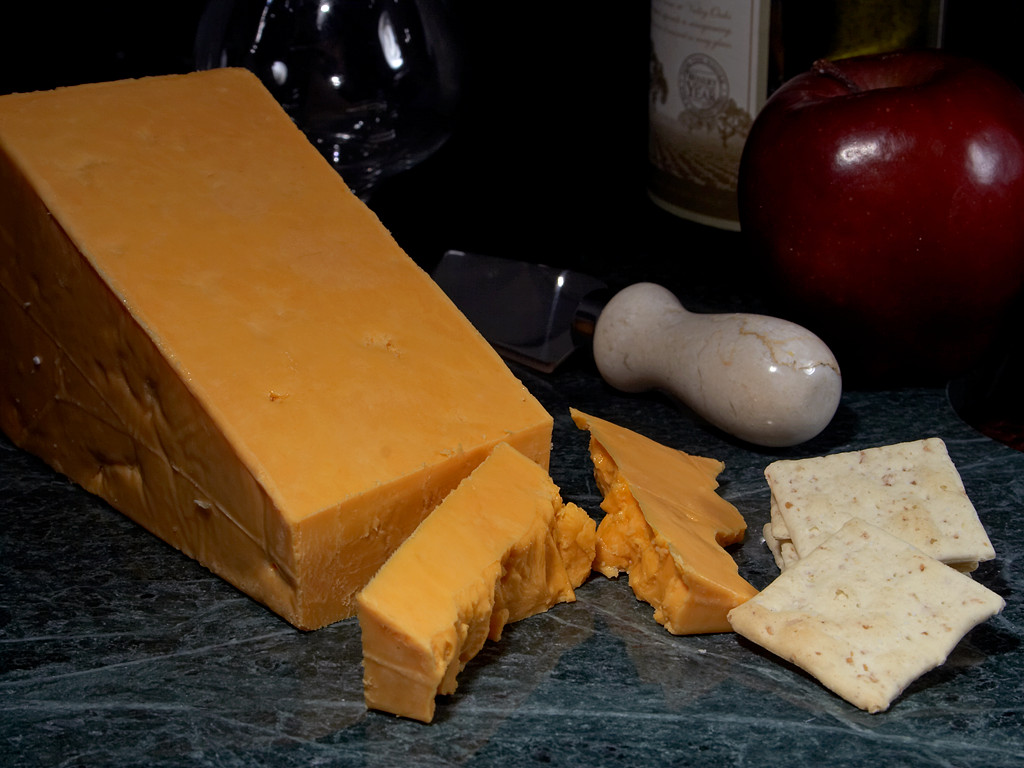 🇬🇧 United KingdomRed Leicester
A hard, crumbly cow's-milk cheese from England, aged for months and coloured with annatto.Cow · Hard · Sweet and caramel
🇬🇧 United KingdomRed Leicester
A hard, crumbly cow's-milk cheese from England, aged for months and coloured with annatto.Cow · Hard · Sweet and caramel
 🇬🇧 United KingdomDunlopcàise Dhùn Lùib
A mild Scottish cheese from Ayrshire made with unskimmed cow's milk.Cow · Semi-soft · Sweet and caramel
🇬🇧 United KingdomDunlopcàise Dhùn Lùib
A mild Scottish cheese from Ayrshire made with unskimmed cow's milk.Cow · Semi-soft · Sweet and caramel
Its cousins elsewhere
All hard cheeses 🇲🇽 MexicoPanela cheeseQueso panela
A fresh, white Mexican cow's-milk cheese that holds its shape when fried.Cow · Fresh · Milky and fresh
🇵🇰 Pakistan and 1 moreKadchgall
A hard, sweet and salty cylindrical cheese made from sheep or camel milk by Pashtun communities.Sheep · Hard · Sweet and caramel
🇻🇪 VenezuelaPalmitaqueso palmita
A fresh, salty cow's milk cheese from Venezuela's Zulia state, made in large wooden vats.Cow · Fresh · Salty
🇲🇽 MexicoPanela cheeseQueso panela
A fresh, white Mexican cow's-milk cheese that holds its shape when fried.Cow · Fresh · Milky and fresh
🇵🇰 Pakistan and 1 moreKadchgall
A hard, sweet and salty cylindrical cheese made from sheep or camel milk by Pashtun communities.Sheep · Hard · Sweet and caramel
🇻🇪 VenezuelaPalmitaqueso palmita
A fresh, salty cow's milk cheese from Venezuela's Zulia state, made in large wooden vats.Cow · Fresh · Salty
 🇪🇬 EgyptMishمش (meš)
A fermented Egyptian salty cheese aged in buttermilk brine until sharp and pungent.Mixed · Bloomy rind · Salty
🇪🇬 EgyptMishمش (meš)
A fermented Egyptian salty cheese aged in buttermilk brine until sharp and pungent.Mixed · Bloomy rind · Salty