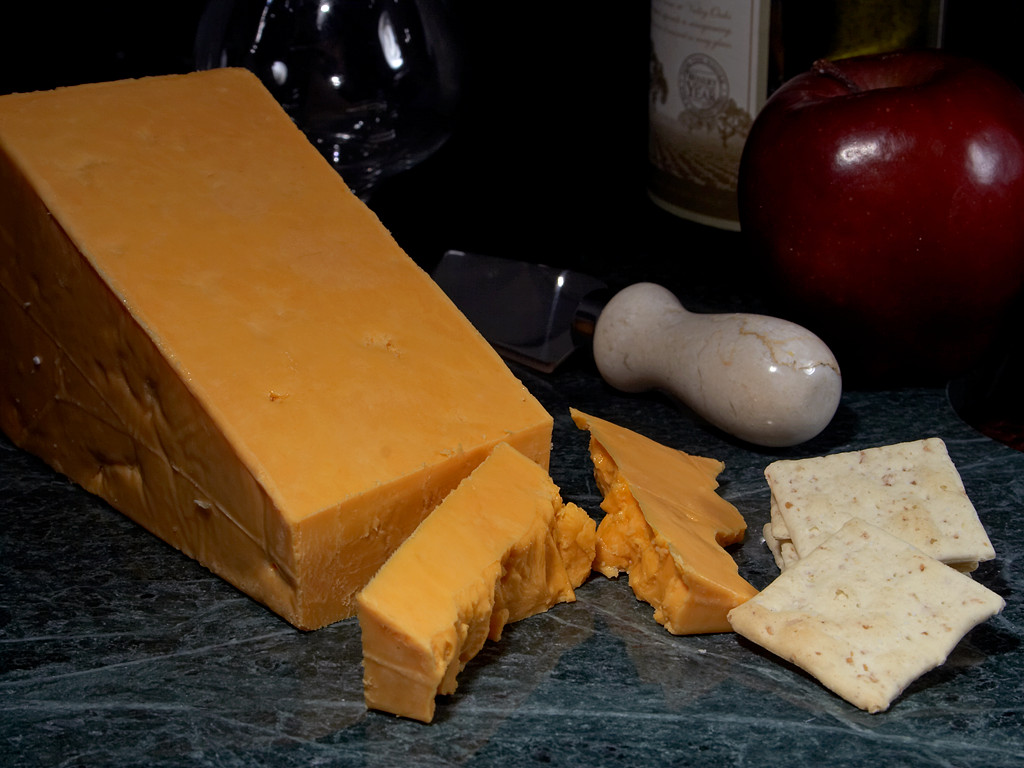
Red Leicester
A hard, crumbly cow's-milk cheese from England, aged for months and coloured with annatto.
Red Leicester is a firm English cheese made from cow's milk. It has a reddish-orange rind and a texture that ranges from dry and friable to creamy depending on how it is pressed. The taste is slightly sweet and nutty, becoming tangier as it ages.
- Coloured orange with annatto since the 18th century
- Named after Leicester city or Leicestershire county
- Crumbly texture unlike firmer Cheddar
- Originally used surplus milk from Stilton production
- Aged 6 to 12 months for optimal flavour
What is Red Leicester?
Red Leicester is a hard cheese from England, similar to Cheddar but more crumbly. It is made from cow's milk and gets its distinctive orange colour from annatto extract, a natural dye added since the 18th century. The paste is firm and dry in traditional wheels, or moister and creamier when pressed into blocks by larger producers. A powdery mould often covers the reddish-orange rind. The flavour is mildly sweet and nutty, developing a sharper tang as the cheese matures over several months.
Where does Red Leicester come from?
The cheese originated on farms in Leicestershire, England. It was traditionally made using surplus milk after the production of Stilton was complete. Originally, the cheese was uncoloured or tinted with carrot or beetroot juice. It was once known simply as Leicestershire Cheese. The name changed to Red Leicester to distinguish it from White Leicester, a pale version created during the rationing of the 1940s under national wartime recipes.
What does Red Leicester taste like?
Traditional farmhouse wheels are dry and friable, offering a mellow, slightly sweet taste that grows stronger with age. Industrial block versions are moister and have a creamy texture with a sweet aftertaste. All versions share a subtle nutty note. Young cheeses, aged around four months, are very mild. After six months, they develop enough tang to be considered old. The flavour profile remains consistent whether vacuum-packed or cloth-aged, though the latter may offer deeper development.
How Red Leicester is made
Production involves acidification, coagulation, cutting, cheddaring, pressing, and aging. Milk is set and the curds are processed similarly to Cheddar. Annatto is added during manufacture to achieve the orange hue. Wheels are traditionally wrapped in cloth for maturation, while modern industrial methods often use vacuum packing. The fat content is typically 33% total, or 48% fat in dry matter. Production takes roughly three to fourteen months to complete a full wheel.
Red Leicester, drawn
How Red Leicester is eaten and cooked
This cheese is versatile in the kitchen. It works well sliced on a cheese board or eaten as a snack. Its melting properties make it suitable for cooking, such as in sauces or grilled dishes. The crumbly texture allows it to grate easily over meals. Supermarket versions are widely available, though some artisanal producers sell uncoloured versions for those who prefer the natural white paste.
Red Leicester through the day
Red Leicester fits into daily eating habits rather than special occasions. It serves as a common snack or lunch component. On a cheese board, it pairs well with other firm cheeses. Its melting quality makes it a practical choice for dinner preparations where a cheesy sauce or topping is desired. It is not typically associated with breakfast or dessert courses.
Red Leicester in the world's kitchens
The cheese is a staple of English cuisine. It reflects the agricultural traditions of Leicestershire and the wider United Kingdom. While originally a farm product, it is now produced by large creameries alongside smaller makers. The style influences British cheese consumption, offering a distinct alternative to Cheddar. Its availability in supermarkets ensures it remains a familiar part of everyday British food culture.
At a glance: where it turns up
Custom and folk tradition
Historically, farmers made this cheese to utilize milk left over from Stilton production. This practice linked it to the broader dairy traditions of the region. The shift from vegetable dyes like beetroot to annatto marks a change in local manufacturing customs. The distinction between White and Red Leicester highlights how wartime necessities altered local food identities permanently.
Protection and trade
Regulations require stating minimum fat levels in terms of fat in dry matter due to moisture loss during aging. Most versions sold in supermarkets contain annatto, though uncoloured options exist. Modern production relies heavily on vacuum packing for aging efficiency. Traditional cloth-wrapped methods persist among smaller farmhouse makers to enhance flavour. The cheese remains primarily produced within the United Kingdom.
Questions people ask about Red Leicester
What kind of milk is used to make Red Leicester?
Red Leicester is made exclusively from cow's milk. The fat content is typically around 33 percent, or 48 percent fat in dry matter. This rich milk base contributes to its creamy yet firm texture.
Where does Red Leicester cheese come from?
It originates from England, specifically the area around Leicester and Leicestershire. It was historically made on farms using surplus milk after Stilton production was finished.
Why is Red Leicester orange?
The orange colour comes from adding annatto extract, a natural vegetable dye. This practice began in the 18th century. Some modern versions remain uncoloured if no dye is added.
How long is Red Leicester aged?
It is typically aged between six and twelve months. Younger versions are mild, while older ones develop a sharper tang. Vacuum packing is common, though cloth wrapping is still used by artisans.
What does Red Leicester taste like?
It has a slightly sweet and nutty flavour. Traditional wheels are dry and friable, while block versions are moister and creamier. The taste becomes stronger and tangier as the cheese ages longer.
Good reading and sources
The facts on this page come from the Wikipedia article "Red Leicester", written by its contributors and used under the CC BY-SA 4.0 licence, and from its Wikidata record (CC0). EveryCheese rewrote the text in its own words, with AI assistance, and compares every page with the article to make sure no passage is copied. It may be reused under the same CC BY-SA 4.0 licence with a link back.
It may contain mistakes. Recipes, ageing and customs differ from one dairy, valley or kitchen to the next. Folk beliefs are described as tradition, never as advice. If something is wrong, tell us. Last refreshed 2026-10-15.
More from the United Kingdom
All the cheeses of the United Kingdom 🇬🇧 United Kingdom and 1 moreMarble cheese
A processed cow's milk cheese with distinct colored marbling patterns.Cow · Hard · Savoury and brothy
🇬🇧 United Kingdom and 1 moreMarble cheese
A processed cow's milk cheese with distinct colored marbling patterns.Cow · Hard · Savoury and brothy
 🇬🇧 United KingdomCaerphilly
A hard, crumbly cow's-milk cheese from South Wales with a mild lemony taste.Cow · Hard · Tangy and lactic
🇬🇧 United KingdomCaerphilly
A hard, crumbly cow's-milk cheese from South Wales with a mild lemony taste.Cow · Hard · Tangy and lactic
 🇬🇧 United Kingdom and 1 moreCheshire
A dense, crumbly cow's-milk cheese from the English county of Cheshire.Cow · Hard · Salty
🇬🇧 United Kingdom and 1 moreCheshire
A dense, crumbly cow's-milk cheese from the English county of Cheshire.Cow · Hard · Salty
 🇬🇧 United KingdomDunlopcàise Dhùn Lùib
A mild Scottish cheese from Ayrshire made with unskimmed cow's milk.Cow · Semi-soft · Sweet and caramel
🇬🇧 United KingdomDunlopcàise Dhùn Lùib
A mild Scottish cheese from Ayrshire made with unskimmed cow's milk.Cow · Semi-soft · Sweet and caramel
Its cousins elsewhere
All hard cheeses 🇮🇳 IndiaKalari
A semi-soft cow or buffalo milk cheese from Jammu and Kashmir, dried and sautéed until gooey.Cow · Semi-soft · Savoury and brothy
🇺🇸 United StatesCold-pack cheese
A chilled blend of natural cheeses mixed with flavorings without cooking.Mixed · Bloomy rind · Savoury and brothy
🇮🇳 IndiaKalari
A semi-soft cow or buffalo milk cheese from Jammu and Kashmir, dried and sautéed until gooey.Cow · Semi-soft · Savoury and brothy
🇺🇸 United StatesCold-pack cheese
A chilled blend of natural cheeses mixed with flavorings without cooking.Mixed · Bloomy rind · Savoury and brothy
 🇮🇳 IndiaKalimpong cheese
A mild, crumbly cow's-milk cheese from a West Bengal hill station, started by a Jesuit priest.Cow · Semi-hard · Tangy and lactic
🇮🇳 IndiaKalimpong cheese
A mild, crumbly cow's-milk cheese from a West Bengal hill station, started by a Jesuit priest.Cow · Semi-hard · Tangy and lactic