
Stinking Bishop
A washed-rind cow's-milk cheese from Gloucestershire, ripened in perry.
Stinking Bishop is a semi-soft washed-rind cheese made from Old Gloucester cow's milk in Dymock, England. It is ripened for four months by washing the rind with local pear cider, giving it a strong aroma and creamy texture.
- Made from Old Gloucester cow's milk in Dymock, England.
- Ripened for four months with weekly washes in local perry.
- Wheels weigh two kilograms with an orange-grey rind.
- Created in 1972 to save the endangered Old Gloucester breed.
- Won gold at the 2010 British Cheese Awards.
What is Stinking Bishop?
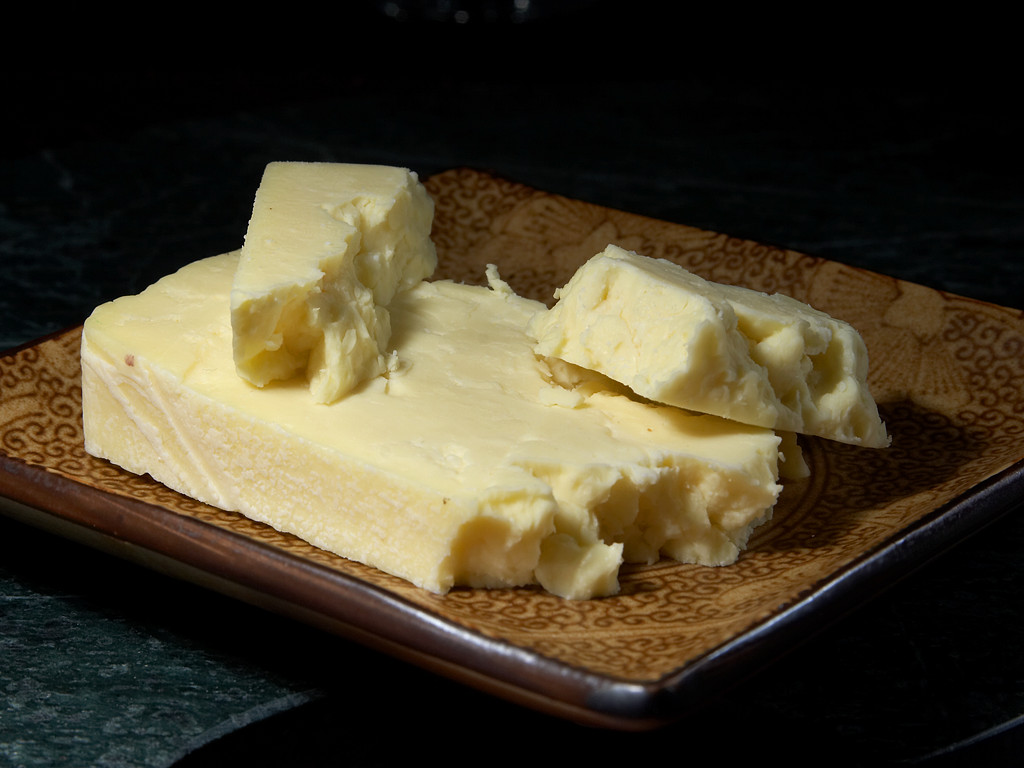
Stinking Bishop is a semi-soft cheese with a smooth, creamy texture. It is moulded into wheels weighing two kilograms, measuring twenty centimetres across and four centimetres deep. The paste ranges from white-yellow to beige. The rind is orange to grey. The cheese gets its name from the Stinking Bishop pear used in its production. It has a distinctive odour caused by the ripening process. The fat content is forty-eight percent. Only about one thousand wheels are produced each year.
Where does Stinking Bishop come from?
The cheese was first produced in 1972 by Charles Martell at Hunts Court Farm in Dymock, Gloucestershire. Martell bought surviving Old Gloucester cattle to promote the endangered breed. He began making cheese from their milk to raise interest. By 2016, the breed numbers had recovered to around four hundred fifty cows. Martell's own herd remained small, so he combined the milk with Friesian milk from other farms for economic viability. The cheese is handmade and not sold in supermarkets.
What does Stinking Bishop taste like?
The cheese has a strong, pungent aroma due to the washing process. The taste is savoury and tangy. The texture is smooth and creamy. The rind is washed every four weeks during maturation. This encourages bacterial activity and increases moisture. Salt is added only after the cheese leaves the mould. The use of local perry gives the cheese a unique character distinct from other washed-rind varieties.
How Stinking Bishop is made
Milk from Old Gloucester cows is pasteurised and mixed with Friesian milk. The curd is moulded into wheels. Salt is applied after removal from the mould to increase moisture. The cheese is ripened for four months. During this time, the rind is washed in perry made from Stinking Bishop pears. This happens every four weeks. The process encourages specific bacteria to grow on the surface. This creates the characteristic orange-grey rind and strong smell.
Stinking Bishop, drawn
How Stinking Bishop is eaten and cooked
The cheese is served on its own or on a cheese board. It is available in artisan food stores and delicatessens. Some stockists include major department stores like Harrods. It is eaten as a snack or part of a meal. The strong flavour pairs well with crusty bread. It is not typically melted or baked. The creamy texture makes it suitable for spreading.
Stinking Bishop through the day
Stinking Bishop is primarily a snack or appetizer. It fits well on a cheese board with crackers. It can be eaten alone as a tasting item. The strong aroma makes it less suitable for light lunches. It is often enjoyed with perry or cider. It is not associated with breakfast or dessert.
Stinking Bishop in the world's kitchens
The cheese is a British specialty from Gloucestershire. It is popular in the UK among cheese enthusiasts. International attention grew after its appearance in Wallace & Gromit. It is featured in British cooking shows and awards. The cheese represents traditional English artisanal dairy farming.
At a glance: where it turns up
By meal and use
Cuisines

Faith and ritual
There are no known religious associations with Stinking Bishop. It is not tied to any specific faith or ritual. The production is secular and commercial.
Stinking Bishop at celebrations
The cheese won a gold medal at the British Cheese Awards in 2010. It was named King of Cheese in a Channel 4 show. It is not linked to specific festivals or holidays. Its popularity surged after a cartoon feature.
Custom and folk tradition
The cheese supports the conservation of the Old Gloucester breed. Charles Martell started production to save the cattle from extinction. The use of local perry reflects regional agricultural traditions. The handmade method preserves artisanal cheesemaking skills.
Buying, keeping and serving Stinking Bishop
Store the cheese in the refrigerator. Wrap it in wax paper or cheese paper. Consume within a few days of opening. The strong odour should be contained.
Protection and trade
Production is limited to about one thousand wheels yearly. Stockists include Harrods and Selfridges. Demand increased significantly after media exposure. The maker hires additional staff to meet demand. The cheese is not exported widely.
Questions people ask about Stinking Bishop
Where does Stinking Bishop come from?
It comes from Dymock in Gloucestershire, England. Charles Martell started making it in 1972 at Hunts Court Farm.
What milk is used to make it?
It uses pasteurised milk from Old Gloucester cows, mixed with Friesian milk for volume. The Old Gloucester breed was nearly extinct when production began.
Why is it called Stinking Bishop?
The name comes from the Stinking Bishop pear. The cheese rind is washed in perry made from these local pears during ripening.
How long is it aged?
It is aged for about four months. The rind is washed every four weeks with perry to develop its flavour and aroma.
What does it taste like?
It has a smooth, creamy texture and a strong, pungent aroma. The taste is savoury and tangy, with notes from the pear cider wash.
Good reading and sources
The facts on this page come from the Wikipedia article "Stinking Bishop", written by its contributors and used under the CC BY-SA 4.0 licence, and from its Wikidata record (CC0). EveryCheese rewrote the text in its own words, with AI assistance, and compares every page with the article to make sure no passage is copied. It may be reused under the same CC BY-SA 4.0 licence with a link back.
It may contain mistakes. Recipes, ageing and customs differ from one dairy, valley or kitchen to the next. Folk beliefs are described as tradition, never as advice. If something is wrong, tell us. Last refreshed 2026-10-15.
More from the United Kingdom
All the cheeses of the United Kingdom 🇬🇧 United KingdomLancashire cheese
A cow's-milk cheese from England with creamy, nutty, or crumbly varieties.Cow · Semi-hard · Nutty
🇬🇧 United KingdomLancashire cheese
A cow's-milk cheese from England with creamy, nutty, or crumbly varieties.Cow · Semi-hard · Nutty
 🇬🇧 United KingdomDunlopcàise Dhùn Lùib
A mild Scottish cheese from Ayrshire made with unskimmed cow's milk.Cow · Semi-soft · Sweet and caramel
🇬🇧 United KingdomDunlopcàise Dhùn Lùib
A mild Scottish cheese from Ayrshire made with unskimmed cow's milk.Cow · Semi-soft · Sweet and caramel
 🇬🇧 United KingdomWensleydale
A medium, crumbly British cheese originally from sheep's milk in North Yorkshire.Cow · Semi-soft · Sweet and caramel
🇬🇧 United KingdomWensleydale
A medium, crumbly British cheese originally from sheep's milk in North Yorkshire.Cow · Semi-soft · Sweet and caramel
 🇬🇧 United KingdomTintern
A soft, blended cow's milk Cheddar flavoured with chives and shallots, wrapped in lime green wax.Cow · Semi-soft · Herbal and grassy
🇬🇧 United KingdomTintern
A soft, blended cow's milk Cheddar flavoured with chives and shallots, wrapped in lime green wax.Cow · Semi-soft · Herbal and grassy
Its cousins elsewhere
All semi-soft cheeses 🇮🇳 IndiaKalimpong cheese
A mild, crumbly cow's-milk cheese from a West Bengal hill station, started by a Jesuit priest.Cow · Semi-hard · Tangy and lactic
🇮🇳 IndiaKalimpong cheese
A mild, crumbly cow's-milk cheese from a West Bengal hill station, started by a Jesuit priest.Cow · Semi-hard · Tangy and lactic
 🇮🇳 IndiaKalari
A semi-soft cow or buffalo milk cheese from Jammu and Kashmir, dried and sautéed until gooey.Cow · Semi-soft · Savoury and brothy
🇺🇸 United StatesCold-pack cheese
A chilled blend of natural cheeses mixed with flavorings without cooking.Mixed · Bloomy rind · Savoury and brothy
🇨🇳 ChinaKefir cheese
A tangy, creamy cheese set using kefir culture rather than rennet or acid.Mixed · Fresh · Tangy and lactic
🇮🇳 IndiaKalari
A semi-soft cow or buffalo milk cheese from Jammu and Kashmir, dried and sautéed until gooey.Cow · Semi-soft · Savoury and brothy
🇺🇸 United StatesCold-pack cheese
A chilled blend of natural cheeses mixed with flavorings without cooking.Mixed · Bloomy rind · Savoury and brothy
🇨🇳 ChinaKefir cheese
A tangy, creamy cheese set using kefir culture rather than rennet or acid.Mixed · Fresh · Tangy and lactic