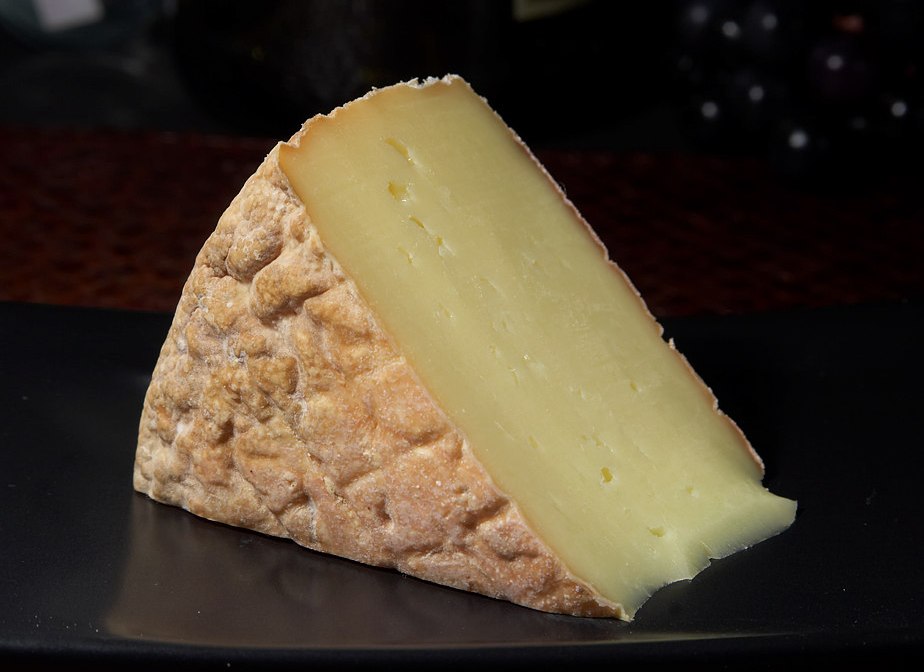
Gubbeen
A washed-rind semi-soft cow's milk cheese from County Cork, Ireland.
Gubbeen is a surface-ripened, semi-soft cheese made from pasteurized cow's milk in Schull, County Cork. It features a pink and white rind with creamy, mushroomy, and nutty flavors that deepen as it matures. The Ferguson family has produced this cheese at their farm since 1979.
- Produced since 1979 by the Ferguson family in County Cork.
- Features a pink and white washed rind developed by daily cleaning.
- Flavors range from creamy to mushroomy and nutty as it matures.
- Made from pasteurized milk of mixed breed cows including Kerry and Jersey.
- Won gold medals at the British Cheese Awards in 2010 and 2016.
What is Gubbeen?
Gubbeen is a semi-soft cheese with a distinctive pink and white rind. Made from pasteurized cow's milk, it is shaped into wheels approximately fifteen centimeters wide and five centimeters high. Each wheel weighs about one kilogram two hundred grams, though smaller four-hundred-gram versions exist. The paste is creamy, offering flavors of mushrooms and nuts that become more pronounced as the cheese ages. A smoked variant is also produced by the makers.
Where does Gubbeen come from?
The cheese has been crafted since 1979 by Tom and Giana Ferguson at Gubbeen Farm near Schull in County Cork. The name derives from the Irish word goibín, meaning a small beak or mouth, which names the townland where the farm sits. The Ferguson family uses milk exclusively from their own herd, which includes British Friesian, Simmental, Jersey, and Kerry cows.
What does Gubbeen taste like?
The taste profile is primarily creamy, supported by distinct notes of earthy mushrooms and roasted nuts. These characteristics evolve significantly with time. Younger wheels offer milder creaminess, while mature examples develop deeper, more complex savory layers. The washed rind contributes to the pungent aroma and rich texture associated with surface-ripened cheeses.
How Gubbeen is made
Milk from the farm's mixed-breed herd is stored in vats before starter cultures and rennet are introduced to coagulate it. The resulting curds are cut and stirred until they reach the desired consistency. The cheese is then formed and placed in curing rooms. Here, the rind is washed daily, a crucial step that encourages the growth of beneficial bacteria and creates the unique pinkish surface bloom.
Gubbeen, drawn
How Gubbeen is eaten and cooked
Gubbeen is typically served on a cheese board or enjoyed as a standalone snack. Its semi-soft texture and bold flavor make it suitable for pairing with crusty bread or crackers. The smoked version can be used in cooking where a smoky dairy element is desired, though it is often eaten simply to appreciate its developed taste.
Gubbeen through the day
This cheese fits comfortably into daily eating routines. It serves well as an afternoon snack or part of a casual lunch. On a cheese board, it provides a strong counterpoint to milder varieties. It is not traditionally associated with breakfast or dessert courses.
Gubbeen in the world's kitchens
Gubbeen is a staple of modern Irish farmhouse cheesemaking. Produced in County Cork, it represents a contemporary approach to traditional dairy crafts. The cheese has gained recognition both within Ireland and at international competitions, including gold medals at the British Cheese Awards.
At a glance: where it turns up

Faith and ritual
There are no specific religious associations or ritual uses linked to Gubbeen cheese. It is a secular product made for general consumption without ties to monastic traditions or dietary laws.
Gubbeen at celebrations
While not tied to specific festivals, Gubbeen is celebrated through numerous awards. It has received silver and gold medals at national and international cheese competitions, highlighting its quality among peers. These accolades mark it as a distinguished product in the Irish food landscape.
Custom and folk tradition
The production method reflects a hands-on, artisanal tradition. Daily washing of the rind is a labor-intensive practice that distinguishes it from natural-rind cheeses. The use of milk from a diverse herd of local breeds adds a unique regional character to the final product, rooted in the specific terroir of South West Ireland.
Buying, keeping and serving Gubbeen
Store the cheese in the refrigerator, wrapped in wax paper or cheese cloth to allow it to breathe. Consume within a few weeks of purchase for the best texture and flavor. The washed rind requires careful handling to maintain its integrity.
What to use instead of Gubbeen
However, other washed-rind semi-soft cheeses might offer similar flavor profiles, though none replicate the specific bacterial bloom developed at Gubbeen Farm.
Protection and trade
Gubbeen Farmhouse Products continues to produce the cheese using methods established in 1979. The brand has achieved significant acclaim, winning multiple gold medals at the British Cheese Awards for both standard and smoked varieties. Production remains centered at the original farm in Schull.
Questions people ask about Gubbeen
Where does Gubbeen cheese come from?
It is made in Schull, County Cork, Ireland, at Gubbeen Farm. The name comes from the Irish word for a small beak, referring to the local townland.
What kind of milk is used to make Gubbeen?
Gubbeen is made from pasteurized cow's milk sourced from the farm's own herd, which includes British Friesian, Simmental, Jersey, and Kerry breeds.
How would you describe the taste of Gubbeen?
It tastes creamy with distinct notes of mushrooms and nuts. The flavor becomes deeper and more complex as the cheese matures over time.
What makes the rind of Gubbeen special?
The rind is washed daily during ripening. This process creates a distinctive pink and white bloom and develops the cheese's characteristic savory flavors.
Good reading and sources
The facts on this page come from the Wikipedia article "Gubbeen Farmhouse Cheese", written by its contributors and used under the CC BY-SA 4.0 licence, and from its Wikidata record (CC0). EveryCheese rewrote the text in its own words, with AI assistance, and compares every page with the article to make sure no passage is copied. It may be reused under the same CC BY-SA 4.0 licence with a link back.
It may contain mistakes. Recipes, ageing and customs differ from one dairy, valley or kitchen to the next. Folk beliefs are described as tradition, never as advice. If something is wrong, tell us. Last refreshed 2026-10-15.
More from Ireland
All the cheeses of Ireland 🇮🇪 IrelandSt Tola
Handmade goat's milk cheese from Inagh, County Clare, ranging from fresh logs to aged wheels.Goat · Fresh · Tangy and lactic
🇮🇪 IrelandSt Tola
Handmade goat's milk cheese from Inagh, County Clare, ranging from fresh logs to aged wheels.Goat · Fresh · Tangy and lactic
 🇫🇷 France and 3 moreBrie
A soft, pale French cow's-milk cheese with a white mould rind, aged for about five weeks.Cow · Bloomy rind · Nutty
🇮🇪 IrelandWicklow Farmhouse Cheese
A range of handmade cow's milk cheeses from Arklow, Ireland, spanning soft bries to hard cheddars.Cow · Bloomy rind · Nutty
🇫🇷 France and 3 moreBrie
A soft, pale French cow's-milk cheese with a white mould rind, aged for about five weeks.Cow · Bloomy rind · Nutty
🇮🇪 IrelandWicklow Farmhouse Cheese
A range of handmade cow's milk cheeses from Arklow, Ireland, spanning soft bries to hard cheddars.Cow · Bloomy rind · Nutty
Its cousins elsewhere
All semi-soft cheeses 🇨🇦 CanadaLe Riopelle de l'Isle
A soft triple-cream cow's milk cheese from Isle-aux-Grues in Quebec.Cow · Bloomy rind · Buttery and creamy
🇨🇦 CanadaLe Riopelle de l'Isle
A soft triple-cream cow's milk cheese from Isle-aux-Grues in Quebec.Cow · Bloomy rind · Buttery and creamy
 🇸🇾 SyriaTresseجبنة مشللة
A braided Syrian string cheese with a nutty aroma and springy texture.Cow · Semi-soft · Nutty
🇸🇾 SyriaTresseجبنة مشللة
A braided Syrian string cheese with a nutty aroma and springy texture.Cow · Semi-soft · Nutty
 🇺🇸 United StatesMuenster
A semi-soft American cow's-milk cheese with a smooth texture and an orange rind dyed with annatto.Cow · Semi-soft · Nutty
🇺🇸 United StatesMuenster
A semi-soft American cow's-milk cheese with a smooth texture and an orange rind dyed with annatto.Cow · Semi-soft · Nutty
 🇨🇦 CanadaOka
A semi-soft washed-rind cow's milk cheese from Quebec with a copper-orange rind.Cow · Semi-soft · Pungent and funky
🇨🇦 CanadaOka
A semi-soft washed-rind cow's milk cheese from Quebec with a copper-orange rind.Cow · Semi-soft · Pungent and funky