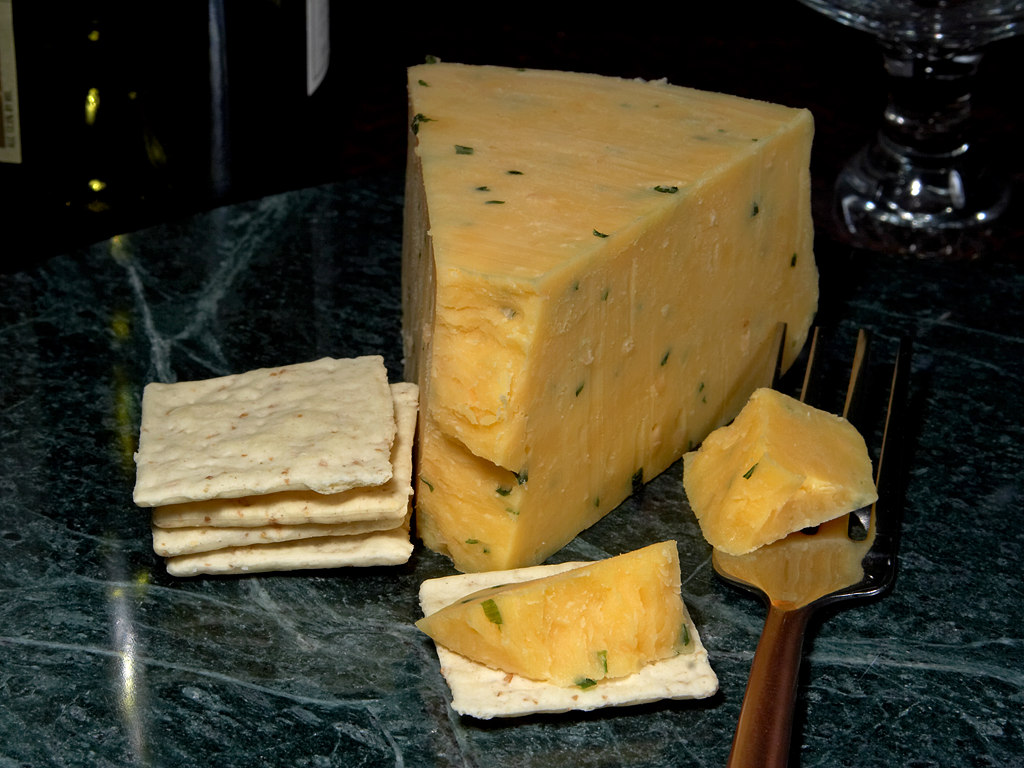
Double Gloucester
A semi-hard cow's-milk cheese from England with a savoury flavour and natural rind.
This traditional English cheese is made in Gloucestershire from the milk of Old Gloucester cattle. It has a firm texture and a stronger, savoury taste than its Single counterpart, often showing a yellow hue from wild flowers.
- Made from Old Gloucester cattle milk traditionally.
- Aged for 36 weeks for a firm, savoury result.
- Yellow colour originally came from lady's bedstraw.
- Central to the Cooper's Hill Cheese-Rolling festival.
- Single Gloucester has PDO status in Gloucestershire.
What is Double Gloucester?
Double Gloucester is a semi-hard cheese originating from Gloucestershire, England. It is traditionally crafted from the milk of Old Gloucester cattle, though modern supermarket versions often use pasteurised milk from other sources. The cheese forms large round wheels with a natural rind. Its paste is firm and slightly denser than Single Gloucester. Historically, the distinct yellow colour came from feeding cows lady's bedstraw, a wild flower known as Galium verum. Today, it presents a more savoury profile compared to the lighter, crumbly Single variety.
Where does Double Gloucester come from?
Cheesemakers have produced Gloucester varieties since the sixteenth century. The tradition relied on the native Gloucester cattle, but their numbers dwindled significantly by the mid-twentieth century. Production of the farmhouse style ceased in the 1950s alongside the decline of the breed. In 1973, Charles Martell rescued remaining Old Gloucester cows and revived the farmhouse Double Gloucester tradition, which was featured in a BBC series. He later restored Single Gloucester in 1978. The Slow Food movement has supported traditional production since 2004.
What does Double Gloucester taste like?
The cheese offers a robust, savoury taste that develops strength as it ages longer than the Single version. Its texture is firmer and less crumbly than its sibling. While historically yellow due to the diet of the cows, modern variations may vary in colour. The flavour profile is distinctively earthy and rich, reflecting the long aging period of thirty-six weeks typical for this style.
How Double Gloucester is made
Traditional methods involve setting the milk from Old Gloucester cows. The curds are processed into large round wheels. Unlike the Single variety, which is consumed sooner, Double Gloucester undergoes a longer ripening period of approximately thirty-six weeks. This extended time allows the texture to firm up and the savoury notes to intensify. Modern industrial versions are often pasteurised and made in creameries rather than on small farms.
Double Gloucester, drawn
How Double Gloucester is eaten and cooked
It is commonly served on cheese boards or eaten as a snack. The firm texture makes it suitable for grating over dishes or melting in cooking. Supermarket versions are often sold as slab cheese under store brands. Traditional farmhouse wheels might be enjoyed simply on their own to appreciate the full savoury character developed during the long aging process.
Double Gloucester through the day
This cheese fits well into lunch or dinner settings, particularly when served on a board with bread or crackers. It also works as a substantial snack. Its versatility allows it to be melted into recipes or grated over meals, making it a practical addition to daily eating routines in England.
Double Gloucester in the world's kitchens
It is a staple of English cuisine, specifically tied to the traditions of Gloucestershire. Historically, Double Gloucester was exported out of the county and prized alongside Cheddar and Cheshire cheeses. Today, it remains a key part of the regional dairy heritage, with specific producers maintaining the farmhouse standards required for Protected Designation of Origin status.
At a glance: where it turns up

Double Gloucester at celebrations
A wheel of Double Gloucester is central to the Cooper's Hill Cheese-Rolling and Wake festival held every spring. Competitors chase the rolling cheese down a steep hillside, with the winner claiming the prize. This event highlights the cheese's cultural significance in the region beyond mere consumption.
Custom and folk tradition
The names 'single' and 'double' have uncertain origins, with theories suggesting they relate to skimming cream twice or adding morning cream to evening milk. Another theory links the name to the height of the wheel. The revival of the Old Gloucester cattle breed by Charles Martell preserved a unique agricultural tradition that had nearly vanished in the 1950s.
Protection and trade
Single Gloucester holds Protected Designation of Origin status, restricting production to Gloucestershire farms using Gloucester cows. As of 2010, six makers produced this protected variety. Most commercial Double Gloucester is made by major dairy companies like Dairy Crest in creameries and sold under supermarket brands. These industrial versions are pasteurised but not processed.
Questions people ask about Double Gloucester
What kind of milk is used to make Double Gloucester?
Traditionally, it is made from the milk of Old Gloucester cattle. Modern supermarket versions often use pasteurised cow's milk from other breeds.
Where does Double Gloucester come from?
It originates from Gloucestershire, England, where it has been produced since the sixteenth century. It is a key part of the local dairy heritage.
How does Double Gloucester taste?
It has a strong, savoury flavour and a firm texture. It is richer and more intense than Single Gloucester due to its longer aging period.
Why is it called Double Gloucester?
The name's origin is unclear. Theories include skimming cream twice, adding morning cream to evening milk, or the wheel being twice the height of Single.
Good reading and sources
- BBC Radio 4 - The Food Programme, A Taste of Britain: RevisitedBBC, Article
- ‘You just have to roll’: Gloucestershire cheese-rolling race has international appealThe Guardian, Article
- Gloucester cheese on WikipediaEncyclopedia
- More photos on Wikimedia CommonsPhotos and video
- Wikidata recordOpen data
The facts on this page come from the Wikipedia article "Gloucester cheese", written by its contributors and used under the CC BY-SA 4.0 licence, and from its Wikidata record (CC0). EveryCheese rewrote the text in its own words, with AI assistance, and compares every page with the article to make sure no passage is copied. It may be reused under the same CC BY-SA 4.0 licence with a link back.
It may contain mistakes. Recipes, ageing and customs differ from one dairy, valley or kitchen to the next. Folk beliefs are described as tradition, never as advice. If something is wrong, tell us. Last refreshed 2026-10-15.
More from the United Kingdom
All the cheeses of the United Kingdom 🇬🇧 United KingdomLancashire cheese
A cow's-milk cheese from England with creamy, nutty, or crumbly varieties.Cow · Semi-hard · Nutty
🇬🇧 United KingdomLancashire cheese
A cow's-milk cheese from England with creamy, nutty, or crumbly varieties.Cow · Semi-hard · Nutty
 🇬🇧 United KingdomSage Derby
A semi-hard cow's milk cheese from England with a mottled green rind and sage flavour.Cow · Semi-hard · Herbal and grassy
🇬🇧 United KingdomSage Derby
A semi-hard cow's milk cheese from England with a mottled green rind and sage flavour.Cow · Semi-hard · Herbal and grassy
 🇬🇧 United KingdomCornish Yarg
A semi-hard cow's milk cheese from Cornwall wrapped in nettle leaves.Cow · Semi-hard · Tangy and lactic
🇬🇧 United KingdomCornish Yarg
A semi-hard cow's milk cheese from Cornwall wrapped in nettle leaves.Cow · Semi-hard · Tangy and lactic
Its cousins elsewhere
All semi-hard cheeses 🇾🇪 YemenYemeni cheeseجبنة تعز
A smoked semi-hard sheep or goat milk cheese from Taiz Governorate in Yemen.Sheep · Semi-soft · Savoury and brothy
🇺🇸 United StatesCold-pack cheese
A chilled blend of natural cheeses mixed with flavorings without cooking.Mixed · Bloomy rind · Savoury and brothy
🇾🇪 YemenYemeni cheeseجبنة تعز
A smoked semi-hard sheep or goat milk cheese from Taiz Governorate in Yemen.Sheep · Semi-soft · Savoury and brothy
🇺🇸 United StatesCold-pack cheese
A chilled blend of natural cheeses mixed with flavorings without cooking.Mixed · Bloomy rind · Savoury and brothy
 🇮🇳 IndiaKalari
A semi-soft cow or buffalo milk cheese from Jammu and Kashmir, dried and sautéed until gooey.Cow · Semi-soft · Savoury and brothy
🇮🇳 IndiaKalari
A semi-soft cow or buffalo milk cheese from Jammu and Kashmir, dried and sautéed until gooey.Cow · Semi-soft · Savoury and brothy
 🇲🇽 Mexico and 1 moreAsaderoqueso asadero
A fresh Mexican cheese made from cow and goat milk that melts easily for grilling.Cow · Fresh · Savoury and brothy
🇲🇽 Mexico and 1 moreAsaderoqueso asadero
A fresh Mexican cheese made from cow and goat milk that melts easily for grilling.Cow · Fresh · Savoury and brothy