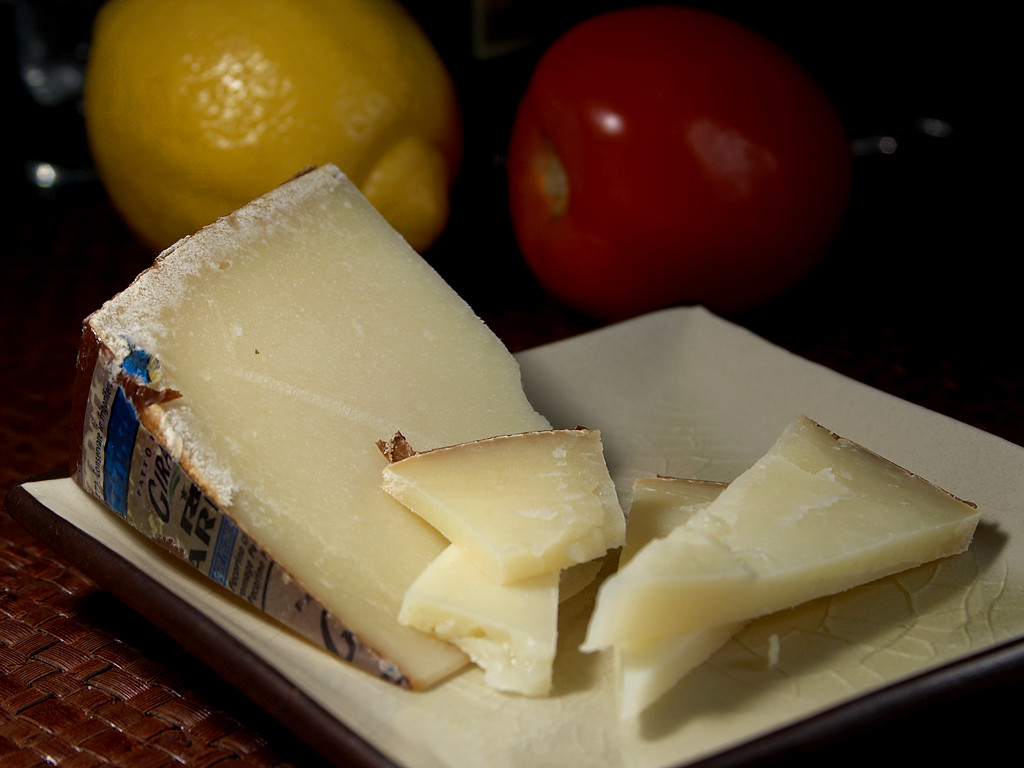
Pecorino Sardo
In its own language: berveghinu sardu
A hard, pressed sheep's milk cheese from Sardinia with two distinct age profiles.
This firm Italian cheese comes from Sardinia and uses the milk of local Sarda sheep. It is salted, moulded, and aged for either a short period or over two months to create mild or sharp versions.
- Made exclusively from Sarda sheep milk in Sardinia.
- Two types: dolce (20-60 days) and maturo (over 2 months).
- Rind ranges from deep yellow to dark brown.
- Received PDO protection in 1996.
- Uses calf rennet to curdle fresh whole milk.
What is Pecorino Sardo?
Pecorino Sardo is a firm, uncooked hard cheese produced in Sardinia. It relies on fresh whole milk from the native Sarda sheep breed. The cheese forms into round wheels that vary by type. The milder version weighs between one and two kilograms. The sharper variety is heavier, reaching up to four kilograms. A deep yellow or dark brown rind wraps around a paste that ranges from white to straw-yellow. The texture is solid and suitable for grating. Flavour intensity shifts directly with how long the wheel rests before sale.
Where does Pecorino Sardo come from?
This cheese belongs to the island of Sardinia in Italy. Producers used traditional methods long before official recognition arrived. The name translates directly to Sardinian pecorino in the local language. Authorities granted denominazione d'origine status in 1991. This was followed by protected designation of origin protection in 1996 when the European Union scheme began. These labels ensure the cheese stays tied to its specific geographic home and local sheep breeds.
What does Pecorino Sardo taste like?
The taste profile depends entirely on the aging timeline. The younger dolce version offers a gentle, milky taste with a hint of salt. It remains soft enough to slice easily. The older maturo style develops a pronounced sharpness. The saltiness becomes more assertive as time passes. The texture stays firm throughout both types. This makes the aged version ideal for grating over hot dishes. The rind adds a slightly tougher bite if left attached.
How Pecorino Sardo is made
Cheesemakers start with fresh whole sheep milk. They add calf rennet to curdle the liquid mixture. Once the curds form, workers salt them thoroughly. The salty curds are then poured into molds to shape the wheels. The molds drain excess moisture while holding the form. After demolding, the wheels undergo a resting period. Shorter aging yields the dolce style. Longer maturation creates the sharper maturo variety. No cooking step is involved in the curd process.
Pecorino Sardo, drawn
How Pecorino Sardo is eaten and cooked
Cooks use this cheese in several ways depending on the age. The young dolce version slices well for sandwiches or platters. It works nicely on cheese boards alongside fruits. The mature maturo style shines when grated. Chefs sprinkle it over pasta dishes to add salt and depth. Its firm structure holds up well under heat. It also serves as a standalone snack with bread.
Pecorino Sardo in the world's kitchens
Sardinian cuisine features this cheese as a staple ingredient. Local cooks rely on it for daily meals across the island. The sheep milk connects directly to the pastoral landscape of Sardinia. Neighboring regions may import it for its distinct salty punch. However, it remains most authentic when paired with local breads and simple vegetable sides. The PDO rules keep production strictly within Sardinian borders.
At a glance: where it turns up
Faith and ritual
No specific religious rituals surround this cheese. Production follows standard agricultural cycles rather than monastic traditions. Shepherds raise the Sarda sheep for wool and meat as well. The cheese provides nutrition for rural communities year-round. It does not carry kosher or halal certifications by default due to animal rennet use.
Pecorino Sardo at celebrations
People eat this cheese during everyday gatherings rather than special festivals. It appears on family tables as a common side dish. The younger wheels often accompany light lunches. The sharper wheels serve as hearty accompaniments to dinner. Farmers might enjoy it after tending their flocks on the hillsides.
Custom and folk tradition
Local herders have raised Sarda sheep for generations. The cheese reflects the island's pastoral history. Molds and salting techniques remain largely unchanged. Families pass down knowledge about aging times. The distinction between sweet and mature styles guides local consumption habits. This binary choice defines how households store and serve the product.
Buying, keeping and serving Pecorino Sardo
Keep the cheese wrapped in wax paper or cheese cloth. Refrigerate it to maintain freshness. Consume the dolce version quickly after opening. The maturo variety lasts longer due to lower moisture content. Bring it to room temperature before serving for better flavour release.
What to use instead of Pecorino Sardo
Cooks sometimes swap in other Pecorino Romano wheels. Both share a hard texture and salty profile. However, Romano lacks the specific sheep breed influence. Other Sardinian pecorinos may work but lack the PDO guarantee. Fresh goat cheeses fail to match the firmness required for grating.
Protection and trade
The European Union protects this name through PDO rules. Only cheese made in Sardinia using local milk qualifies. Producers must follow strict guidelines to earn the label. This protection prevents imitation products from using the name elsewhere. Export markets value the authenticity guaranteed by the certification.
Questions people ask about Pecorino Sardo
What kind of milk is used to make Pecorino Sardo?
It is made from fresh whole sheep milk, specifically from the local Sarda sheep breed found in Sardinia, Italy.
What is the difference between dolce and maturo?
Dolce is aged for 20 to 60 days and tastes mild. Maturo ages for over two months, becoming harder and sharper in flavor.
Where does this cheese come from?
It originates from the Italian island of Sardinia. The name literally means Sardinian pecorino in the local language.
How is the cheese flavored?
The mixture is salted before molding. The final taste ranges from mild and milky to sharp and salty depending on the aging duration.
Good reading and sources
- Pecorino sardo on WikipediaEncyclopedia
- More photos on Wikimedia CommonsPhotos and video
- Wikidata recordOpen data
The facts on this page come from the Wikipedia article "Pecorino sardo", written by its contributors and used under the CC BY-SA 4.0 licence, and from its Wikidata record (CC0). EveryCheese rewrote the text in its own words, with AI assistance, and compares every page with the article to make sure no passage is copied. It may be reused under the same CC BY-SA 4.0 licence with a link back.
It may contain mistakes. Recipes, ageing and customs differ from one dairy, valley or kitchen to the next. Folk beliefs are described as tradition, never as advice. If something is wrong, tell us. Last refreshed 2026-10-15.
More from Italy
All the cheeses of Italy 🇮🇹 Italy and 3 moreParmesanParmigiano Reggiano
A hard, granular cow's-milk cheese aged at least a year in northern Italy.Cow · Hard · Sharp and tangy-aged
🇮🇹 Italy and 3 moreParmesanParmigiano Reggiano
A hard, granular cow's-milk cheese aged at least a year in northern Italy.Cow · Hard · Sharp and tangy-aged
 🇫🇷 France and 2 moreBlue cheese
A family of cheeses defined by blue-green mold veins created through deliberate inoculation and piercing.Cow · Semi-soft · Sharp and tangy-aged
🇫🇷 France and 2 moreBlue cheese
A family of cheeses defined by blue-green mold veins created through deliberate inoculation and piercing.Cow · Semi-soft · Sharp and tangy-aged
 🇮🇹 ItalyPecorino
A family of Italian hard sheep's-milk cheeses with protected status.Sheep · Hard · Buttery and creamy
🇮🇹 ItalyPecorino
A family of Italian hard sheep's-milk cheeses with protected status.Sheep · Hard · Buttery and creamy
 🇮🇹 ItalyGrana Padano
A hard, grainy Italian cow's-milk cheese aged for at least nine months in the Po Valley.Cow · Hard · Nutty
🇮🇹 ItalyGrana Padano
A hard, grainy Italian cow's-milk cheese aged for at least nine months in the Po Valley.Cow · Hard · Nutty
Its cousins elsewhere
All hard cheeses 🇪🇬 EgyptMishمش (meš)
A fermented Egyptian salty cheese aged in buttermilk brine until sharp and pungent.Mixed · Bloomy rind · Salty
🇪🇬 EgyptMishمش (meš)
A fermented Egyptian salty cheese aged in buttermilk brine until sharp and pungent.Mixed · Bloomy rind · Salty
 🇪🇬 Egypt and 1 moreRumiجبنة رومى
A hard, salty Egyptian cow or buffalo milk cheese with a pungent aroma.Cow · Hard · Salty
🇪🇬 Egypt and 1 moreRumiجبنة رومى
A hard, salty Egyptian cow or buffalo milk cheese with a pungent aroma.Cow · Hard · Salty
 🇲🇽 MexicoPanela cheeseQueso panela
A fresh, white Mexican cow's-milk cheese that holds its shape when fried.Cow · Fresh · Milky and fresh
🇻🇪 VenezuelaPalmitaqueso palmita
A fresh, salty cow's milk cheese from Venezuela's Zulia state, made in large wooden vats.Cow · Fresh · Salty
🇲🇽 MexicoPanela cheeseQueso panela
A fresh, white Mexican cow's-milk cheese that holds its shape when fried.Cow · Fresh · Milky and fresh
🇻🇪 VenezuelaPalmitaqueso palmita
A fresh, salty cow's milk cheese from Venezuela's Zulia state, made in large wooden vats.Cow · Fresh · Salty