
Torta del Casar
In its own language: Torta del Casal
A creamy sheep's milk cheese from Extremadura, coagulated with cardoon and aged for at least two months.
This Spanish cheese comes from the Extremadura area and uses only sheep's milk. It has a soft center and a salty taste with a hint of bitterness from wild thistle used in its making.
- Made only from Merino or Entrefina sheep milk
- Uses cardoon pistils instead of animal rennet
- Requires twenty sheep to produce one kilogram
- Aged for a minimum of sixty days
- Named after the town of Casar de Cáceres
What is Torta del Casar?
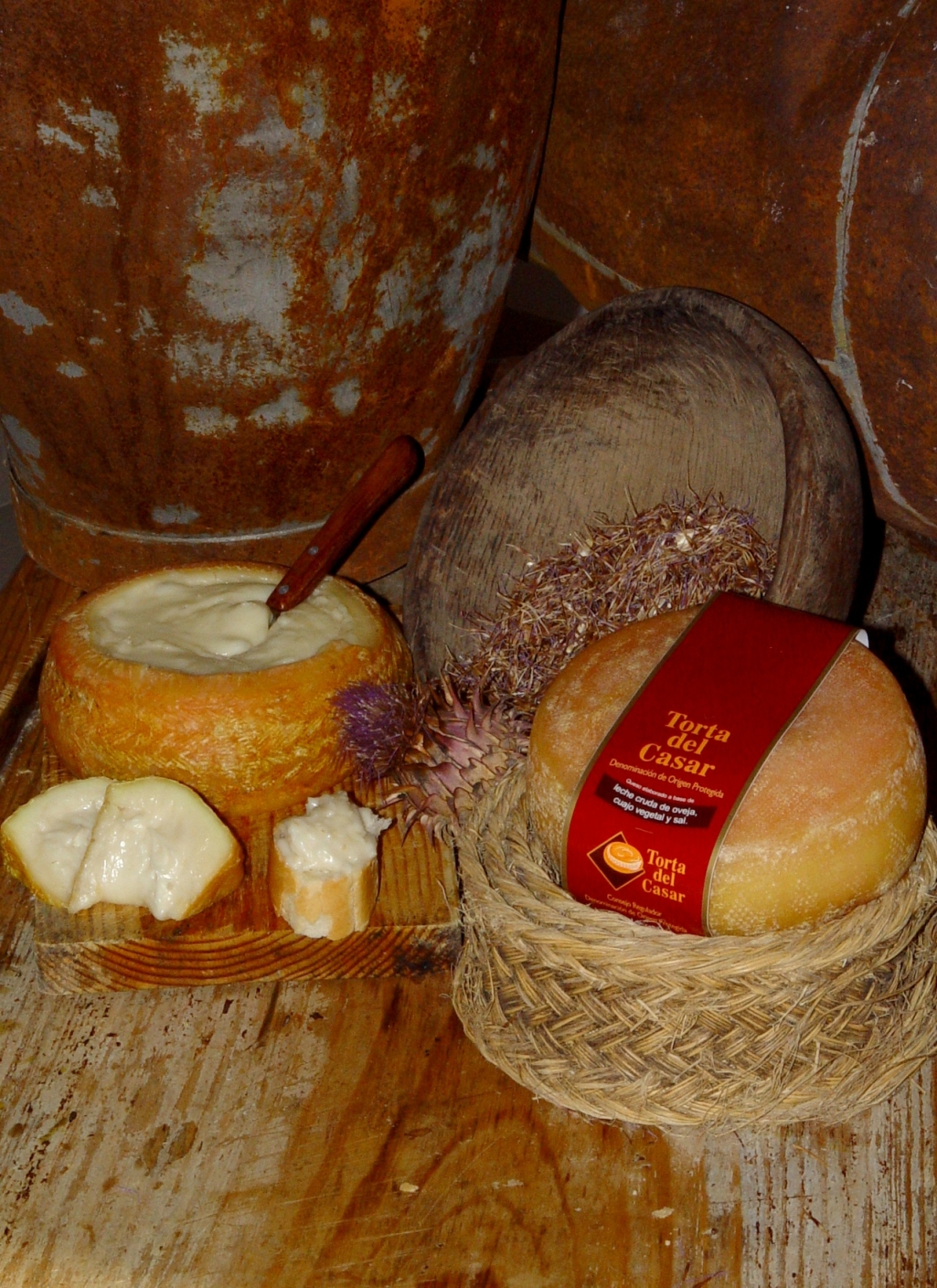
Torta del Casar is a semi-soft cheese produced in Spain using exclusively sheep's milk. The wheel typically weighs one kilogram and features a creamy interior texture that remains unpressed. Its rind is natural and pale, while the paste inside ranges from white to cream. The flavor profile combines richness with a distinct saltiness, finished by a subtle bitter note derived from the plant-based coagulant.
Where does Torta del Casar come from?
The cheese originates in the Extremadura region of Spain. Its name honors the town of Casar de Cáceres, which serves as its place of birth. Local tradition holds that this specific method of production has been practiced in these areas for generations, relying on local sheep breeds and native flora for its unique character.
What does Torta del Casar taste like?
The taste is primarily rich and slightly salty, balanced by a gentle bitterness. This bitter edge comes directly from the cardoon flowers used during processing. As the cheese ages beyond the minimum period, the texture becomes even softer and creamier, allowing the flavors to deepen without losing that characteristic herbal sharpness.
How Torta del Casar is made
Producers use milk from Merino or Entrefina sheep, breeds known for lower yields. To curdle the milk, they employ a coagulant extracted from the pistils of the cardoon, a wild thistle plant. After coagulation, the mixture is not pressed. Instead, it rests for a minimum of sixty days to ripen, developing its signature soft consistency.
Torta del Casar, drawn
How Torta del Casar is eaten and cooked
Eaters traditionally serve this cheese by cutting off the top layer of the rind. They then scoop out the creamy interior with a spoon. It works well as a standalone snack or as part of a cheese board. The soft texture makes it difficult to slice, so scooping remains the standard method of consumption.
Torta del Casar through the day
It fits comfortably into snack time or as an appetizer on a cheese board. Because of its strong flavor and soft texture, it is rarely cooked. People enjoy it simply on its own, often paired with bread or dried fruits to complement the salty and bitter notes.
Torta del Casar in the world's kitchens
Spanish cuisine claims this cheese as a regional specialty. Within Extremadura, it represents local agricultural practices centered on sheep farming. The specific reliance on cardoon and local sheep breeds ties the dish firmly to the geography and culinary habits of this part of Spain.
At a glance: where it turns up
By meal and use
Cuisines
Faith and ritual
No specific religious rituals or dietary laws are tied to this cheese. It does not hold a special place in monastic traditions or fasting periods. It is treated as a secular food item enjoyed for its taste rather than any spiritual significance.
Torta del Casar at celebrations
There are no specific festivals or holiday celebrations dedicated to Torta del Casar. It is available year-round as a regular product. While it may appear at local gatherings, it is not reserved for weddings or new-year feasts specifically.
Custom and folk tradition
Local lore emphasizes the low milk yield of the required sheep breeds. Making a single kilogram of cheese requires the milk from twenty sheep. This fact highlights the labor-intensive nature of traditional production in the region, preserving older methods over industrial efficiency.
Buying, keeping and serving Torta del Casar
Keep the cheese refrigerated to maintain its creamy texture. Once opened, consume it quickly as the soft interior spoils faster than hard cheeses. Wrap it in wax paper or plastic to prevent it from drying out or absorbing other fridge odors.
What to use instead of Torta del Casar
No direct substitutes exist due to the unique cardoon coagulant. Other soft sheep cheeses might mimic the texture but lack the bitter herbal finish. Cooks cannot easily replicate the specific flavor profile found in authentic Torta del Casar.
Protection and trade
The cheese holds Protected Designation of Origin status, granted in 2003. Regulations mandate that production occurs only in designated areas using specified sheep breeds. These rules protect the name and ensure traditional methods are followed, limiting imitation products.
Questions people ask about Torta del Casar
What kind of milk is used?
It is made exclusively from the milk of Merino or Entrefina sheep breeds found in the Extremadura region of Spain.
Where does this cheese come from?
It originates in Spain, specifically named after the town of Casar de Cáceres in the Extremadura area.
How is it flavored?
It tastes rich and salty with a subtle bitterness caused by using cardoon flower pistils as the coagulating agent.
How should I eat it?
Slice off the top rind and scoop out the creamy interior with a spoon, serving it as a snack or on a cheese board.
Good reading and sources
- Torta del Casar on WikipediaEncyclopedia
- More photos on Wikimedia CommonsPhotos and video
- Wikidata recordOpen data
The facts on this page come from the Wikipedia article "Torta del Casar", written by its contributors and used under the CC BY-SA 4.0 licence, and from its Wikidata record (CC0). EveryCheese rewrote the text in its own words, with AI assistance, and compares every page with the article to make sure no passage is copied. It may be reused under the same CC BY-SA 4.0 licence with a link back.
It may contain mistakes. Recipes, ageing and customs differ from one dairy, valley or kitchen to the next. Folk beliefs are described as tradition, never as advice. If something is wrong, tell us. Last refreshed 2026-10-15.
More from Spain
All the cheeses of Spain 🇪🇸 SpainMahónformatge de Maó / queso de Mahón
A cow's-milk cheese from Menorca that ranges from soft and mild to hard and sharp.Cow · Semi-soft · Buttery and creamy
🇪🇸 SpainMahónformatge de Maó / queso de Mahón
A cow's-milk cheese from Menorca that ranges from soft and mild to hard and sharp.Cow · Semi-soft · Buttery and creamy
 🇪🇸 SpainValdeónQueso de Valdeón
A Spanish blue cheese from León wrapped in sycamore or chestnut leavesCow · Semi-soft · Sharp and tangy-aged
🇪🇸 SpainValdeónQueso de Valdeón
A Spanish blue cheese from León wrapped in sycamore or chestnut leavesCow · Semi-soft · Sharp and tangy-aged
 🇪🇸 SpainGarrotxa
A semi-soft Catalan goat cheese with a powdery gray rind and earthy flavor.Goat · Semi-soft · Earthy and cellar
🇪🇸 SpainGarrotxa
A semi-soft Catalan goat cheese with a powdery gray rind and earthy flavor.Goat · Semi-soft · Earthy and cellar
 🇪🇸 SpainPata de mulo cheese
A tubular, hard ewe's-milk cheese from Spain, shaped like a mule's leg.Sheep · Hard · Salty
🇪🇸 SpainPata de mulo cheese
A tubular, hard ewe's-milk cheese from Spain, shaped like a mule's leg.Sheep · Hard · Salty
Its cousins elsewhere
All semi-soft cheeses 🇲🇽 MexicoPanela cheeseQueso panela
A fresh, white Mexican cow's-milk cheese that holds its shape when fried.Cow · Fresh · Milky and fresh
🇵🇰 Pakistan and 1 moreKadchgall
A hard, sweet and salty cylindrical cheese made from sheep or camel milk by Pashtun communities.Sheep · Hard · Sweet and caramel
🇻🇪 VenezuelaPalmitaqueso palmita
A fresh, salty cow's milk cheese from Venezuela's Zulia state, made in large wooden vats.Cow · Fresh · Salty
🇲🇽 MexicoPanela cheeseQueso panela
A fresh, white Mexican cow's-milk cheese that holds its shape when fried.Cow · Fresh · Milky and fresh
🇵🇰 Pakistan and 1 moreKadchgall
A hard, sweet and salty cylindrical cheese made from sheep or camel milk by Pashtun communities.Sheep · Hard · Sweet and caramel
🇻🇪 VenezuelaPalmitaqueso palmita
A fresh, salty cow's milk cheese from Venezuela's Zulia state, made in large wooden vats.Cow · Fresh · Salty
 🇪🇬 EgyptMishمش (meš)
A fermented Egyptian salty cheese aged in buttermilk brine until sharp and pungent.Mixed · Bloomy rind · Salty
🇪🇬 EgyptMishمش (meš)
A fermented Egyptian salty cheese aged in buttermilk brine until sharp and pungent.Mixed · Bloomy rind · Salty