
Shropshire Blue
A pasteurised cow's milk blue cheese with an orange rind and sharp flavour.
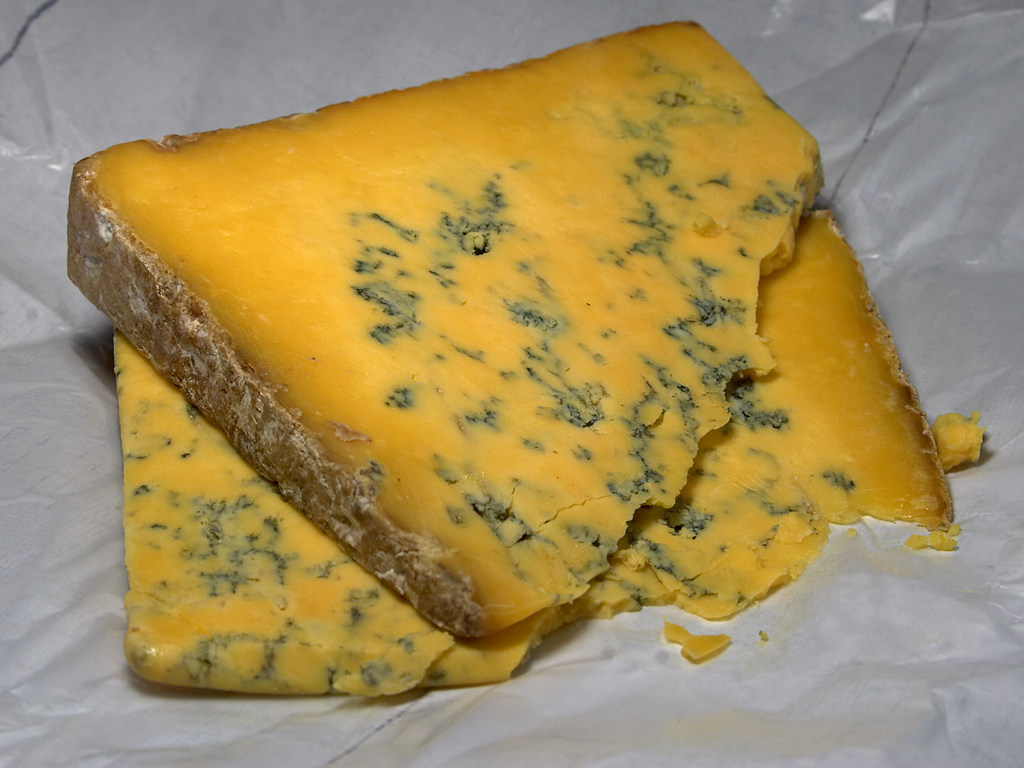
Shropshire Blue is a British blue cheese made from pasteurised cow's milk. It features a distinctive orange hue from annatto and matures for ten to twelve weeks. The cheese offers a sharp, strong taste that is slightly tangy and creamier than Stilton.
- Made from pasteurised cow's milk with vegetable rennet.
- Orange colour comes from annatto added before heating.
- Matures for 10 to 12 weeks to develop flavour.
- Sharp, strong taste with a creamy texture.
- Originally called Inverness-shire Blue or Blue Stuart.
What is Shropshire Blue?
Shropshire Blue is a soft blue cheese produced in the United Kingdom. It is crafted from pasteurised cow's milk and set using vegetable rennet. The paste displays a deep orange colour due to the addition of annatto, a natural food dye. A natural rind covers the wheel, which develops over a maturation period of ten to twelve weeks. The fat content sits at approximately forty-eight percent. The texture is soft and creamy, offering a sharp and strong flavour profile. Its aroma carries a slight tanginess, distinguishing it as sharper than Stilton while maintaining a rich mouthfeel.
Where does Shropshire Blue come from?
The history of Shropshire Blue involves competing claims regarding its creation in the 1970s. One account attributes the cheese to Andy Williamson at the Castle Stuart dairy in Inverness, Scotland. He initially marketed it as 'Inverness-shire Blue' or 'Blue Stuart'. Another claim suggests the cheese originated in Shropshire, potentially linked to Dennis Biggins, who reportedly developed a recipe involving annatto in the 1930s. After Williamson's dairy closed in 1980, Cheshire farmers kept the recipe alive before Colston Bassett Dairies took over production. The name 'Shropshire Blue' was chosen to boost popularity despite the lack of direct geographical ties to the county.
What does Shropshire Blue taste like?
This cheese presents a sharp and strong taste that stands out among blue varieties. It possesses a slightly sour undertone balanced by a distinct tangy aroma. The texture is notably creamy, providing a smooth contrast to the intensity of the flavour. While similar in production method to Stilton, Shropshire Blue delivers a more pronounced punch. The annatto adds visual warmth but does not alter the fundamental savoury character of the milk and mould.
How Shropshire Blue is made
Producers use pasteurised cow's milk as the base for this cheese. Vegetable rennet is employed to coagulate the milk, ensuring the product remains suitable for vegetarians. Annatto is added to the milk prior to heating to impart the characteristic orange colour. Penicillium roqueforti mould is introduced to create the internal veining typical of blue cheeses. The curds are formed into wheels and left to mature for ten to twelve weeks. This timeframe allows the flavours to develop fully and the texture to soften appropriately.
Shropshire Blue, drawn
How Shropshire Blue is eaten and cooked
Shropshire Blue is primarily enjoyed on a cheese board. Its strong flavour makes it a standout item when served alongside crackers or bread. The cheese can be paired with fruits that complement its sharpness. Due to its creamy texture, it melts well, though it is most commonly appreciated in its solid form. It serves as a robust accompaniment to drinks such as beer or wine, cutting through richness with its tangy profile.
Shropshire Blue through the day
This cheese fits comfortably into a dinner setting or as part of an evening snack. It is ideal for a cheese board served after the main course. The intensity of the flavour makes it less suitable for light breakfasts. It works well as a substantial snack during social gatherings. Its pairing potential extends to dessert courses if balanced with sweet elements like honey or figs.
Shropshire Blue in the world's kitchens
Shropshire Blue is firmly rooted in British cuisine. It represents a modern interpretation of traditional blue cheese making within the UK. The cheese appeals to those familiar with English dairy products. Its production methods reflect contemporary artisanal practices adapted from older styles like Stilton. The cheese has gained recognition across the United Kingdom as a distinct local variety.
At a glance: where it turns up
By meal and use
Cuisines
Faith and ritual
There are no specific religious associations or ritual uses documented for Shropshire Blue. The use of vegetable rennet makes it acceptable for vegetarians, but it does not hold special significance in any particular faith tradition. It is not associated with monastic production or specific religious festivals.
Shropshire Blue at celebrations
It is treated as a regular artisanal product rather than a ceremonial item. There are no recorded traditions linking its consumption to new year celebrations or pastoral events.
Custom and folk tradition
Local lore surrounding Shropshire Blue focuses on its disputed origins. Stories vary between Scottish creation in the 1970s and earlier Shropshire roots. The narrative of Dennis Biggins adding annatto in the 1930s persists as a folk tale of innovation. The transition from 'Blue Stuart' to 'Shropshire Blue' highlights marketing strategies over historical continuity. Ludlow Blue, a variant using carotene, continues the tradition of coloured blues in the region.
Buying, keeping and serving Shropshire Blue
Keep the cheese wrapped in wax paper or foil in the refrigerator. Consume it within a few days of opening to enjoy the peak flavour. Allow it to come to room temperature before serving to enhance the aroma. Avoid freezing, as this can damage the creamy texture and affect the mould structure.
Protection and trade
Production has passed through several hands, including Castle Stuart Dairy and Colston Bassett Dairies. The cheese does not hold protected designation status. Variants like Ludlow Blue are produced by small artisan dairies in Shropshire. The market accepts it as a sought-after British cheese, despite its controversial naming origin.
Questions people ask about Shropshire Blue
Where does Shropshire Blue come from?
It is a British cheese made in the United Kingdom. Origins are disputed between Scotland and Shropshire, though the name was likely chosen for marketing appeal rather than geographic accuracy.
What milk is used to make Shropshire Blue?
The cheese is made exclusively from pasteurised cow's milk. The milk is treated with vegetable rennet to ensure it is suitable for vegetarians.
How does Shropshire Blue taste?
It has a sharp, strong flavour that is slightly tangy and sour. The texture is soft and creamy, often described as richer and sharper than Stilton.
Why is Shropshire Blue orange?
The orange hue comes from annatto, a natural food colouring added to the milk before heating. Some variants use carotene instead, resulting in a yellower shade.
Good reading and sources
- Shropshire Blue on WikipediaEncyclopedia
- More photos on Wikimedia CommonsPhotos and video
- Wikidata recordOpen data
The facts on this page come from the Wikipedia article "Shropshire Blue", written by its contributors and used under the CC BY-SA 4.0 licence, and from its Wikidata record (CC0). EveryCheese rewrote the text in its own words, with AI assistance, and compares every page with the article to make sure no passage is copied. It may be reused under the same CC BY-SA 4.0 licence with a link back.
It may contain mistakes. Recipes, ageing and customs differ from one dairy, valley or kitchen to the next. Folk beliefs are described as tradition, never as advice. If something is wrong, tell us. Last refreshed 2026-10-15.
More from the United Kingdom
All the cheeses of the United Kingdom 🇬🇧 United KingdomDorset Blue Vinny
A hard, crumbly cow's-milk blue cheese from Dorset with a strong taste and protected status.Cow · Hard · Sharp and tangy-aged
🇬🇧 United KingdomBuxton Blue
A cylindrical English cow's-milk blue cheese with russet veining, made under PDO rules.Cow · Blue · Savoury and brothy
🇬🇧 United KingdomLanark Blue
A semi-hard blue cheese made from raw sheep's milk in Scotland.Sheep · Semi-hard · Savoury and brothy
🇬🇧 United KingdomDorset Blue Vinny
A hard, crumbly cow's-milk blue cheese from Dorset with a strong taste and protected status.Cow · Hard · Sharp and tangy-aged
🇬🇧 United KingdomBuxton Blue
A cylindrical English cow's-milk blue cheese with russet veining, made under PDO rules.Cow · Blue · Savoury and brothy
🇬🇧 United KingdomLanark Blue
A semi-hard blue cheese made from raw sheep's milk in Scotland.Sheep · Semi-hard · Savoury and brothy
 🇬🇧 United KingdomStichelton
A raw-milk blue cheese made in Nottinghamshire using traditional unpasteurised methods.Cow · Blue · Buttery and creamy
🇬🇧 United KingdomStichelton
A raw-milk blue cheese made in Nottinghamshire using traditional unpasteurised methods.Cow · Blue · Buttery and creamy
Its cousins elsewhere
All blue cheeses 🇮🇳 IndiaKalimpong cheese
A mild, crumbly cow's-milk cheese from a West Bengal hill station, started by a Jesuit priest.Cow · Semi-hard · Tangy and lactic
🇮🇳 IndiaKalimpong cheese
A mild, crumbly cow's-milk cheese from a West Bengal hill station, started by a Jesuit priest.Cow · Semi-hard · Tangy and lactic
 🇮🇳 IndiaKalari
A semi-soft cow or buffalo milk cheese from Jammu and Kashmir, dried and sautéed until gooey.Cow · Semi-soft · Savoury and brothy
🇺🇸 United StatesCold-pack cheese
A chilled blend of natural cheeses mixed with flavorings without cooking.Mixed · Bloomy rind · Savoury and brothy
🇨🇳 ChinaKefir cheese
A tangy, creamy cheese set using kefir culture rather than rennet or acid.Mixed · Fresh · Tangy and lactic
🇮🇳 IndiaKalari
A semi-soft cow or buffalo milk cheese from Jammu and Kashmir, dried and sautéed until gooey.Cow · Semi-soft · Savoury and brothy
🇺🇸 United StatesCold-pack cheese
A chilled blend of natural cheeses mixed with flavorings without cooking.Mixed · Bloomy rind · Savoury and brothy
🇨🇳 ChinaKefir cheese
A tangy, creamy cheese set using kefir culture rather than rennet or acid.Mixed · Fresh · Tangy and lactic