
Brunost
A sweet, caramelized whey cheese from Norway, often sliced thin for lunch.
Brunost is a Norwegian whey cheese made by boiling milk, cream, and whey until the sugars caramelize. It has a firm, brown texture and a sweet, tangy taste that varies with goat milk content. People eat it on sandwiches or waffles as a daily lunch staple.
- Boiling whey with milk creates a sweet, caramelized brown cheese.
- Anne Hov invented the modern version in Gudbrandsdalen in 1863.
- It is a staple of the Norwegian matpakke lunch tradition.
- Goat milk variants add a sharp tang to the sweet base flavor.
- Brazilian requeijão moreno is a similar caramelized milk product.
What is Brunost?
Brunost, which translates to brown cheese, belongs to the mysost family of foods. These are soft products created from whey, milk, and cream rather than standard curds. The mixture boils down into a solid block with a color ranging from light tan to deep brown. The texture sits between a soft spread and a hard sliceable cheese. It does not crumble when cut but holds its shape well. The flavor profile is distinctly sweet, driven by the caramelization of lactose during cooking. Variants containing goat milk add a sharp, tangy note that balances the sugar.
Where does Brunost come from?
The practice of boiling whey dates back over two millennia in Scandinavia. Modern brunost emerged in the mid-nineteenth century thanks to Anne Hov in Gudbrandsdalen. Facing economic hardship, she added cream to boiling whey to create a richer product called feitost. This innovation led to fløtemysost. Later, she introduced goat milk to enhance the flavor, creating Gudbrandsdalsost. A local trader named Ole Kongsli recognized its potential and exported it to Christiania, now Oslo, boosting the regional economy significantly.
What does Brunost taste like?
The primary taste is sweet, resembling caramel due to the reduced milk sugars. The sweetness is balanced by a subtle tanginess. When goat milk is included, as in geitost, the tang becomes more pronounced and chèvre-like. The texture is firm yet slightly softer than Gouda. It slices cleanly without crumbling. Low-fat versions have a higher whey proportion, altering the richness while maintaining the characteristic sweet and savory balance found in all varieties.
How Brunost is made
Producers start with whey, a byproduct of cheesemaking, and combine it with milk and cream. This mixture simmers for several hours in large pots. The heat evaporates water and triggers caramelization of the lactose, turning the liquid brown and thick. The process continues until the desired consistency is reached. Some makers use iron pots, which historically added iron to the cheese, though modern methods often use aluminum. The final product is packed and refrigerated immediately after cooling.
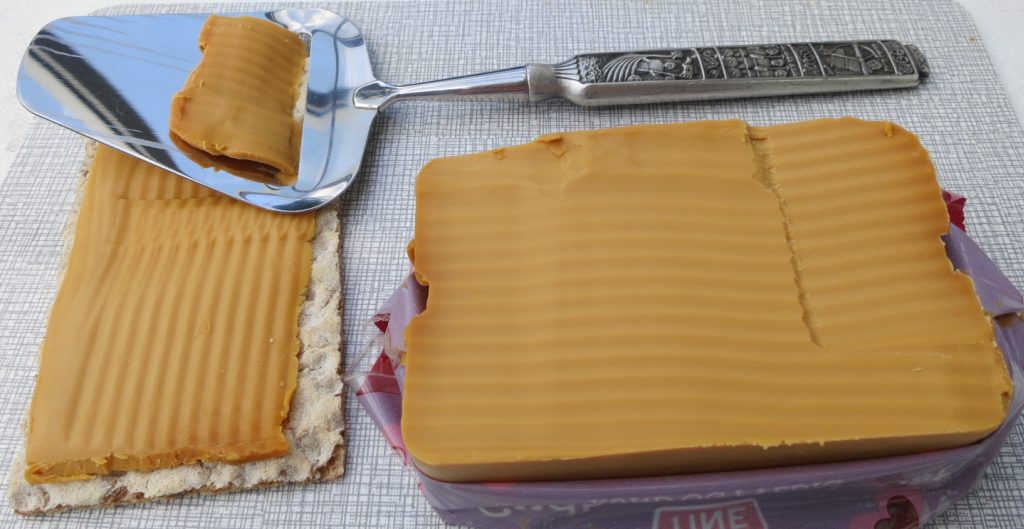
Brunost, drawn
How Brunost is eaten and cooked
Norwegians typically serve brunost thinly sliced on bread or crispbread. It is a standard component of matpakke, the traditional packed lunch eaten at work or school. The cheese also appears on waffles as a topping. In cooking, it serves as an ingredient in sauces, particularly gravies for game meats. Its stable flavor allows it to remain tasty even if it warms up briefly outside the refrigerator during transport.
Brunost through the day
This cheese is a cornerstone of the Norwegian lunch hour. It accompanies the matpakke, a packed meal carried in a box for the midday break. It functions as a snack or light meal rather than a dinner course. Occasionally, it appears on breakfast tables alongside waffles. While primarily a lunch item, its versatility allows it to be enjoyed as a simple snack throughout the day.
Brunost in the world's kitchens
Brunost is central to Norwegian culinary identity. It is widely consumed across the country and represents a key part of national heritage. The cheese has gained popularity in South Korea as well. Internationally, especially in the United States, it is often sold under the name gjetost. The Gudbrandsdal variety remains the most recognized export, distinguishing Norwegian cuisine through its unique sweet and salty profile derived from whey processing.
At a glance: where it turns up

Custom and folk tradition
Anne Hov’s invention transformed rural life in Gudbrandsdalen. Her method provided economic relief during a period of agricultural decline. The cheese became a symbol of resilience and ingenuity in Norwegian farming communities. Local traders played a crucial role in spreading the product beyond the valley. The tradition of eating it with lunch reflects a practical approach to food, utilizing available dairy byproducts efficiently.
Buying, keeping and serving Brunost
Brunost should be kept refrigerated to maintain its texture. If left out, it may soften but retains its flavor. Sliced portions can be stored in the fridge for short periods. The cheese does not require special aging conditions once produced. It is ready to eat immediately after packaging. Consumers should check expiration dates as freshness impacts the optimal texture for slicing.
What to use instead of Brunost
Brazilian requeijão moreno offers a similar experience. It is made by boiling cow's milk until caramelized, resulting in a brown, sweet paste. While unrelated technically, its flavor and appearance closely mimic brunost. Other whey cheeses like primost provide a milder alternative. For those seeking a tangy contrast, goat cheeses might substitute in salads, though they lack the caramel sweetness.
Protection and trade
Tine is the largest producer, offering thirteen varieties plus prim types. Synnøve Finden is the second-largest manufacturer. Smaller artisanal producers exist in Norway and the US. The cheese faces nutritional debates regarding high sugar and fat content. Historical production in iron pots added iron, but modern bans prevent this addition. Despite controversies, it remains a commercially successful and culturally significant product in Norway.
Questions people ask about Brunost
What is brunost made from?
Brunost is a whey cheese made by boiling a mixture of whey, milk, and cream. The heat caramelizes the lactose sugars, giving it a brown color and sweet taste. Some varieties include goat milk for extra tang.
Where does brunost come from?
It originates in Norway, specifically associated with the Gudbrandsdalen valley. Anne Hov developed the modern recipe there in the nineteenth century. It is now a national icon and popular in South Korea.
How does brunost taste?
It tastes sweet and caramel-like due to boiled-down milk sugars. Varieties with goat milk have a sharper, tangier flavor. The texture is firm but sliceable, similar to a soft Gouda.
How is brunost typically eaten?
Norwegians slice it thinly and put it on bread or crispbread for lunch. It is common in packed lunches called matpakke. It also goes on waffles or melts into savory game meat gravies.
Good reading and sources
- Brunost: the Norwegian cheese thatThe Guardian, Article
- Norway goat cheese fire closes tunnelBBC, Article
- Artisanal Sognefjord Geitost - Presìdi Slow FoodSlow Food Foundation, Article
- Brunost on WikipediaEncyclopedia
- More photos on Wikimedia CommonsPhotos and video
- Wikidata recordOpen data
The facts on this page come from the Wikipedia article "Brunost", written by its contributors and used under the CC BY-SA 4.0 licence, and from its Wikidata record (CC0). EveryCheese rewrote the text in its own words, with AI assistance, and compares every page with the article to make sure no passage is copied. It may be reused under the same CC BY-SA 4.0 licence with a link back.
It may contain mistakes. Recipes, ageing and customs differ from one dairy, valley or kitchen to the next. Folk beliefs are described as tradition, never as advice. If something is wrong, tell us. Last refreshed 2026-10-15.
More from Norway
All the cheeses of Norway 🇬🇷 Greece and 5 moreWhey cheese
A dairy product made from the liquid remaining after curds are separated during cheesemaking.Mixed · Whey · Sweet and caramel
🇳🇴 NorwayNøkkelost
A Norwegian cow's-milk cheese flavoured with cumin and cloves, aged for three months.Cow · Semi-hard · Savoury and brothy
🇳🇴 NorwayFløtemysost
A mild brown cheese from Norway made with cow's milk and cream.Cow · Semi-hard · Sweet and caramel
🇬🇷 Greece and 5 moreWhey cheese
A dairy product made from the liquid remaining after curds are separated during cheesemaking.Mixed · Whey · Sweet and caramel
🇳🇴 NorwayNøkkelost
A Norwegian cow's-milk cheese flavoured with cumin and cloves, aged for three months.Cow · Semi-hard · Savoury and brothy
🇳🇴 NorwayFløtemysost
A mild brown cheese from Norway made with cow's milk and cream.Cow · Semi-hard · Sweet and caramel
 🇳🇴 NorwayGamalostgammelost
A firm, sour Norwegian cheese made from skimmed cow's milk and aged for several weeks.Cow · Semi-hard · Tangy and lactic
🇳🇴 NorwayGamalostgammelost
A firm, sour Norwegian cheese made from skimmed cow's milk and aged for several weeks.Cow · Semi-hard · Tangy and lactic
Its cousins elsewhere
All whey cheeses 🇮🇳 IndiaKalimpong cheese
A mild, crumbly cow's-milk cheese from a West Bengal hill station, started by a Jesuit priest.Cow · Semi-hard · Tangy and lactic
🇮🇳 IndiaKalimpong cheese
A mild, crumbly cow's-milk cheese from a West Bengal hill station, started by a Jesuit priest.Cow · Semi-hard · Tangy and lactic
 🇮🇳 IndiaKalari
A semi-soft cow or buffalo milk cheese from Jammu and Kashmir, dried and sautéed until gooey.Cow · Semi-soft · Savoury and brothy
🇺🇸 United StatesCold-pack cheese
A chilled blend of natural cheeses mixed with flavorings without cooking.Mixed · Bloomy rind · Savoury and brothy
🇮🇱 Israel and 1 moreGvina levanaגבינה לבנה
A soft, unripened cow's-milk cheese spread on bread in Israel.Cow · Fresh · Tangy and lactic
🇮🇳 IndiaKalari
A semi-soft cow or buffalo milk cheese from Jammu and Kashmir, dried and sautéed until gooey.Cow · Semi-soft · Savoury and brothy
🇺🇸 United StatesCold-pack cheese
A chilled blend of natural cheeses mixed with flavorings without cooking.Mixed · Bloomy rind · Savoury and brothy
🇮🇱 Israel and 1 moreGvina levanaגבינה לבנה
A soft, unripened cow's-milk cheese spread on bread in Israel.Cow · Fresh · Tangy and lactic